

Generative AI has moved from a niche technology to a daily business tool in just a few years. Whether it’s ChatGPT drafting emails, Google Gemini summarising reports, Microsoft Copilot assisting with documents, or AI-powered search engines answering questions, artificial intelligence is now woven into how people work, research, and make decisions.
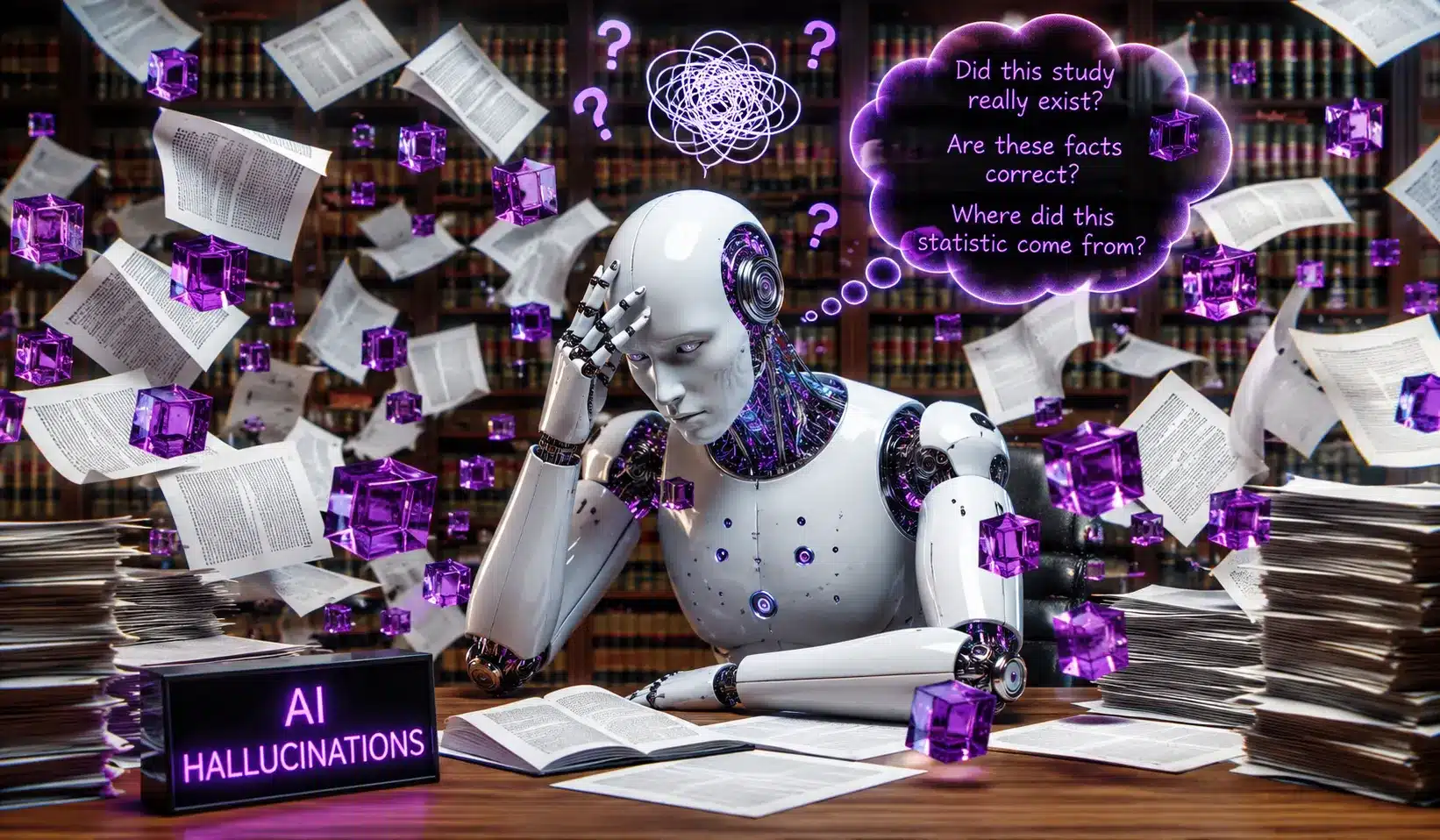
An AI chatbot might invent a statistic that never existed, cite a research paper that was never published, or confidently explain a historical event using made-up facts. The response looks polished. The writing feels authoritative. Yet the information is false. This phenomenon is known as an AI hallucination.
As businesses increasingly rely on AI for content creation, research, customer support, and decision-making, understanding AI hallucinations has become more important than ever. This trend reflects a broader shift toward workplace automation, where AI tools are becoming part of everyday business operations.
These are some of the same areas where AI automation is helping organisations streamline repetitive tasks and improve operational efficiency.
In fact, studies evaluating leading large language models have found that hallucination rates can vary significantly depending on the task, with factual accuracy often dropping when AI systems are asked complex, specialised, or highly specific questions.
In this guide, we’ll explore what AI hallucinations are, why they happen, real-world examples, and most importantly, how to spot them before they create problems for individuals or businesses.
What Are AI Hallucinations?
An AI hallucination occurs when an artificial intelligence system generates information that sounds plausible but is factually incorrect, misleading, or entirely fabricated. In simple terms, the AI creates an answer that isn’t grounded in reality, yet presents it as if it were true.
The term may sound unusual because machines don’t literally hallucinate the way humans do. Instead, the phrase describes situations where AI systems “see” patterns or generate information that doesn’t actually exist. That’s why you’ll often hear experts refer to these incidents as hallucinations in large language models or simply hallucinations in AI.
Here’s a simple example. Imagine asking an AI assistant to recommend a research paper on a specific topic. Rather than admitting it doesn’t know, the system might generate a convincing title, list fictional authors, and even provide a publication date. Everything looks legitimate except none of it is real.
This is where understanding the AI hallucination meaning becomes important. A hallucination isn’t just a minor typo or calculation error. It’s a response that contains invented facts, fabricated references, false statistics, or inaccurate conclusions presented with confidence.
Modern AI models, including popular chatbots, are trained to generate fluent language. Their primary goal is often to predict the most likely sequence of words based on patterns learned from massive datasets. The challenge is that producing a convincing answer isn’t the same as producing a correct one.
Understanding how generative AI differs from predictive AI can also help explain why some AI systems create new content while others focus on forecasting outcomes from existing data.
Why Do AI Hallucinations Happen?
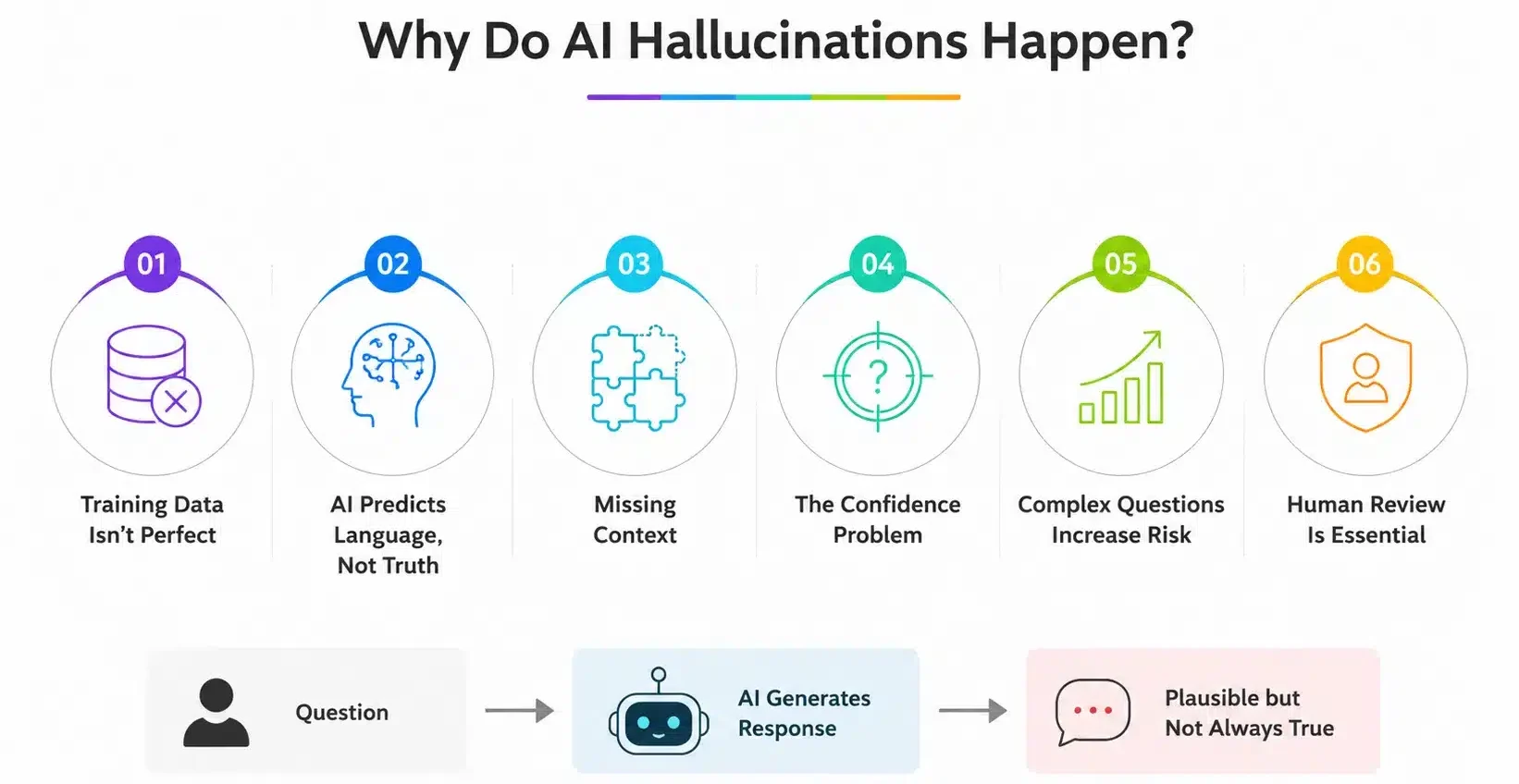
AI systems such as ChatGPT, Gemini, Claude, and other large language models aren’t databases that retrieve facts like a search engine. Instead, they predict what words are most likely to come next based on patterns learned during training.
Most of the time, that works remarkably well. Occasionally, though, the system fills gaps with information that sounds right rather than information that is actually right. That’s where many LLM hallucinations begin.
Training Data Isn’t Perfect
Every AI model learns from enormous amounts of text collected from books, articles, websites, research papers, forums, and other public sources. While this dataset is vast, it’s not complete.
Some information may be outdated. Some topics may be underrepresented. Certain facts may never have appeared in the training data at all.
When an AI encounters a question that sits outside its knowledge boundaries, it often tries to generate the most probable answer instead of acknowledging uncertainty. Think of it like a student answering an exam question they only partially remember. Sometimes they get it right. Sometimes they guess.
AI Predicts Language, Not Truth
Large language models are designed to predict language patterns, not verify facts in real time.
If you ask an AI to write a paragraph about a historical event, it doesn’t independently check museums, archives, or academic databases before responding. It generates text based on probability.
This explains what causes hallucinations in LLMs more than anything else. The model’s objective is fluency and relevance, not fact-checking.
Missing Context Creates Problems
Another major cause of AI hallucinations is incomplete context. Ask a vague question and the model may fill in the blanks on its own.
For example, if a user requests “the latest statistics” without specifying a source, industry, location, or timeframe, the AI may attempt to infer what information is needed. Sometimes those assumptions are correct. Sometimes they’re wildly off the mark.
The Confidence Problem
One of the most fascinating aspects of generative AI hallucinations is that confidence often has little relationship to accuracy.
Humans tend to trust information when it’s presented clearly and confidently. AI systems know how to write in exactly that style.
That’s why users sometimes mistake confidence for credibility, a dangerous assumption when decisions involve finances, healthcare, legal matters, or strategic planning.
Complex Questions Increase Risk
Research consistently shows that hallucination rates tend to rise when questions become highly specialised.
Medical terminology, legal interpretations, niche technical subjects, and emerging industry trends often present greater challenges. In these situations, the AI has fewer reliable patterns to work with, increasing the likelihood of generating AI false information or inaccurate conclusions.
This is one reason why experts stress the importance of human review when AI is used in professional environments.
Can ChatGPT Hallucinate?
The short answer is yes. The reality is that ChatGPT hallucinations are a well-documented phenomenon. While modern AI models have become significantly more accurate over the past few years, they can still generate incorrect information, fabricated references, and unsupported claims.
What makes these hallucinations particularly challenging is that they rarely look like mistakes. A typo stands out. A broken website produces an error message. But when ChatGPT hallucinates, the response often appears polished, logical, and highly detailed. That’s why many users don’t immediately question it.
Consider a common example. A user asks for academic studies supporting a specific marketing strategy. Instead of admitting it cannot find relevant sources, the AI may generate realistic-looking paper titles, author names, journal references, and publication dates. Everything appears legitimate until someone attempts to verify the citations.
This issue has become so common that universities, researchers, and businesses increasingly require independent verification of AI-generated references.
The answer goes back to how large language models work. ChatGPT doesn’t “know” facts the way humans do. It predicts likely responses based on patterns found during training. When information is unclear, incomplete, or unavailable, the model may attempt to fill the gap with content that sounds plausible rather than content that has been verified.
AI Hallucination Examples in the Real World
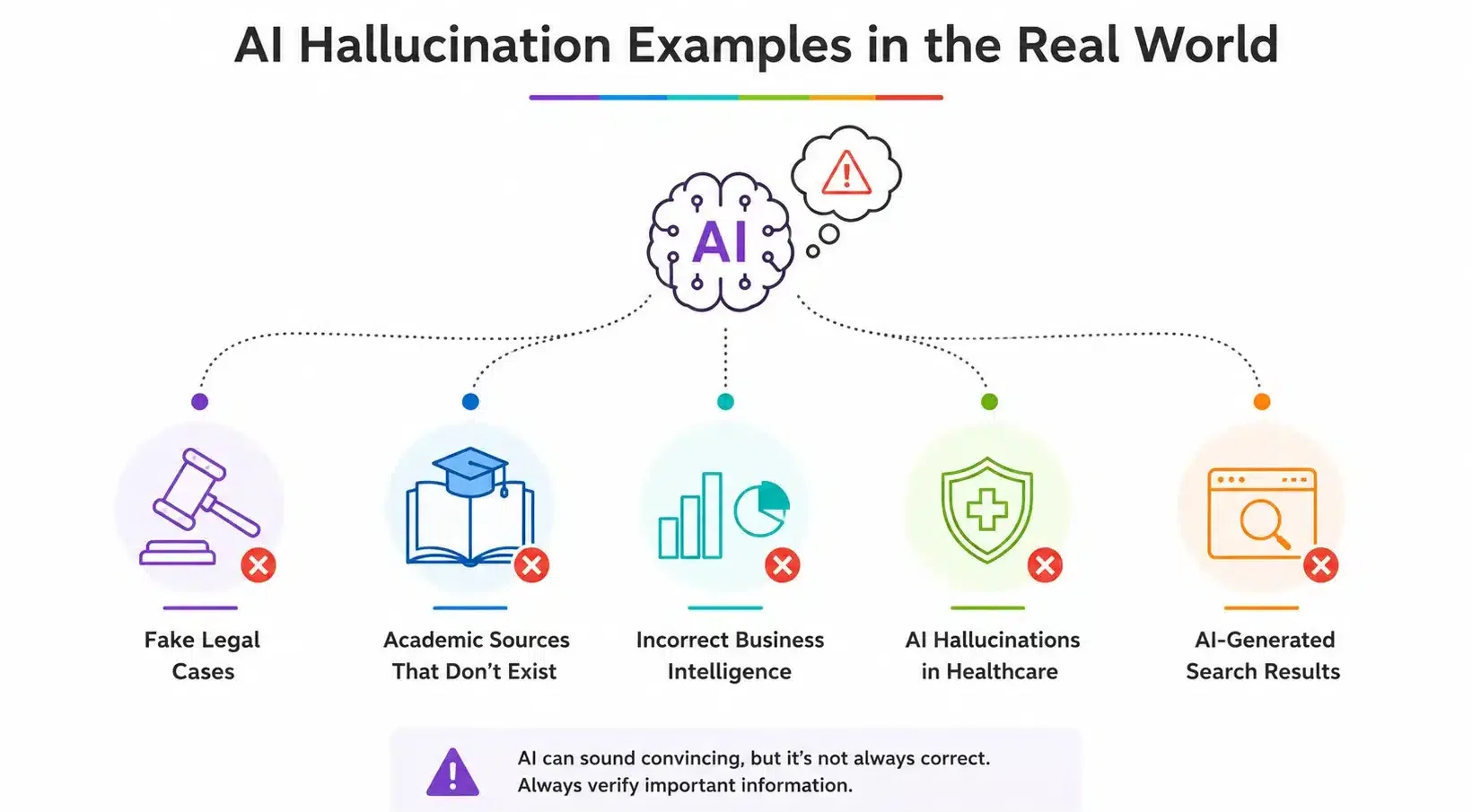
Many people assume AI hallucinations are rare or harmless. In reality, they have already affected businesses, researchers, lawyers, healthcare professionals, and everyday users. Some incidents have been embarrassing. Others have carried serious consequences.
Let’s look at a few real-world examples of AI hallucinations and what they teach us about the risks of relying on AI-generated information without verification.
When AI Invented Legal Cases
One of the most widely discussed examples involved lawyers who used ChatGPT to assist with legal research. The AI-generated court cases appeared genuine. It provided case names, legal arguments, citations, and supporting details. The problem? Several of the cases didn’t exist.
The lawyers submitted the information in court filings before the fabricated references were discovered. The incident quickly became international news and highlighted how easily AI can create content that looks authoritative while being entirely fictional. This remains one of the clearest examples of AI-fabricated references causing real-world problems.
Academic Sources That Never Existed
Researchers and students have encountered similar issues. As technology becomes more deeply integrated into education, verifying AI-generated research references has become an essential academic skill.
Ask an AI model for studies supporting a specific topic, and it may occasionally generate convincing citations that cannot be found in academic databases. The paper title sounds authentic. The journal name looks familiar. The publication year seems reasonable.
Yet after searching Google Scholar, PubMed, or university databases, nothing appears. These cases illustrate why AI citation errors have become a growing concern in education and research. As AI writing tools become more common, source verification is becoming just as important as fact-checking.
Incorrect Business Intelligence
Businesses are increasingly using AI to summarise reports, analyse competitors, and identify market opportunities. Most of the time, these tools provide valuable insights. However, there have been cases where AI systems produced incorrect market statistics, misidentified competitors, or cited outdated information as current data.
Imagine building a marketing campaign around a statistic that sounds impressive but doesn’t actually exist. The content might perform poorly, damage credibility, or lead decision-makers in the wrong direction. This is a common form of AI making up facts not because the system intends to deceive, but because it’s predicting likely information rather than verifying it.
AI Hallucinations in Healthcare
Several studies evaluating healthcare-focused AI systems have found instances where models generated inaccurate medical advice, incorrect treatment recommendations, or unsupported clinical information. While many healthcare organisations use strict review processes, the examples highlight why human expertise remains essential.
The risk of AI hallucinations in healthcare isn’t simply that information may be wrong. It’s that patients and professionals may trust information that appears medically sound. That’s a dangerous combination.
Search Engines and AI-Generated Answers
As search engines integrate generative AI into their results, users sometimes receive summaries containing factual inaccuracies or misleading interpretations. These incidents have fueled broader discussions about AI-generated misinformation and the responsibility of technology companies to improve accuracy.
The challenge is that users often trust search results by default. When an AI-generated answer appears at the top of the page, many assume it has already been verified.
A Pattern Emerges
The problem isn’t that AI generates nonsense. If it did, users would spot errors immediately. The real challenge is that hallucinations often look believable. They contain realistic details, professional language, and logical structure. In some cases, they may even include a mixture of correct and incorrect information, making the errors harder to identify.
That’s why understanding AI hallucination examples matters so much. The more familiar you are with how hallucinations appear in the real world, the easier it becomes to recognise them before they influence decisions, research, or business outcomes. And that raises an important question: if hallucinations can look so convincing, just how common are they?
How Common Are AI Hallucinations?
After seeing real-world examples, many people start wondering: How common are AI hallucinations?
Hallucination rates vary depending on the AI model, the type of task, and the complexity of the question being asked. A chatbot may perform exceptionally well when summarising a document, yet struggle when generating niche legal citations or discussing highly specialised medical research.
Recent evaluations of leading large language models have found that accuracy can range widely depending on the benchmark being measured. In some factual tasks, modern models achieve impressive results. In others, especially those involving complex reasoning or domain-specific knowledge, error rates remain significant.
This creates an interesting contradiction. Generative AI is becoming more capable every year, yet hallucinations haven’t disappeared. In some situations, improved fluency can actually make inaccuracies harder to spot because the answers sound more polished than ever.
So, how accurate is generative AI?
content drafting, brainstorming, and summarisation, today’s AI tools can often deliver highly useful results. However, accuracy tends to decline when questions require precise facts, current information, regulatory knowledge, or expert-level analysis.
Industries such as healthcare, finance, law, and scientific research face particularly high risks because even small factual errors can have serious consequences.
This is why discussions around AI reliability issues continue to grow alongside AI adoption. Organisations aren’t just asking whether AI can produce content; they’re asking whether that content can be trusted.
The encouraging news is that awareness is increasing. Businesses are moving away from blind acceptance of AI outputs and toward structured review processes. As a result, the conversation is shifting from “Can AI make mistakes?” to “How can we identify those mistakes before they matter?”
How to Detect AI Hallucinations
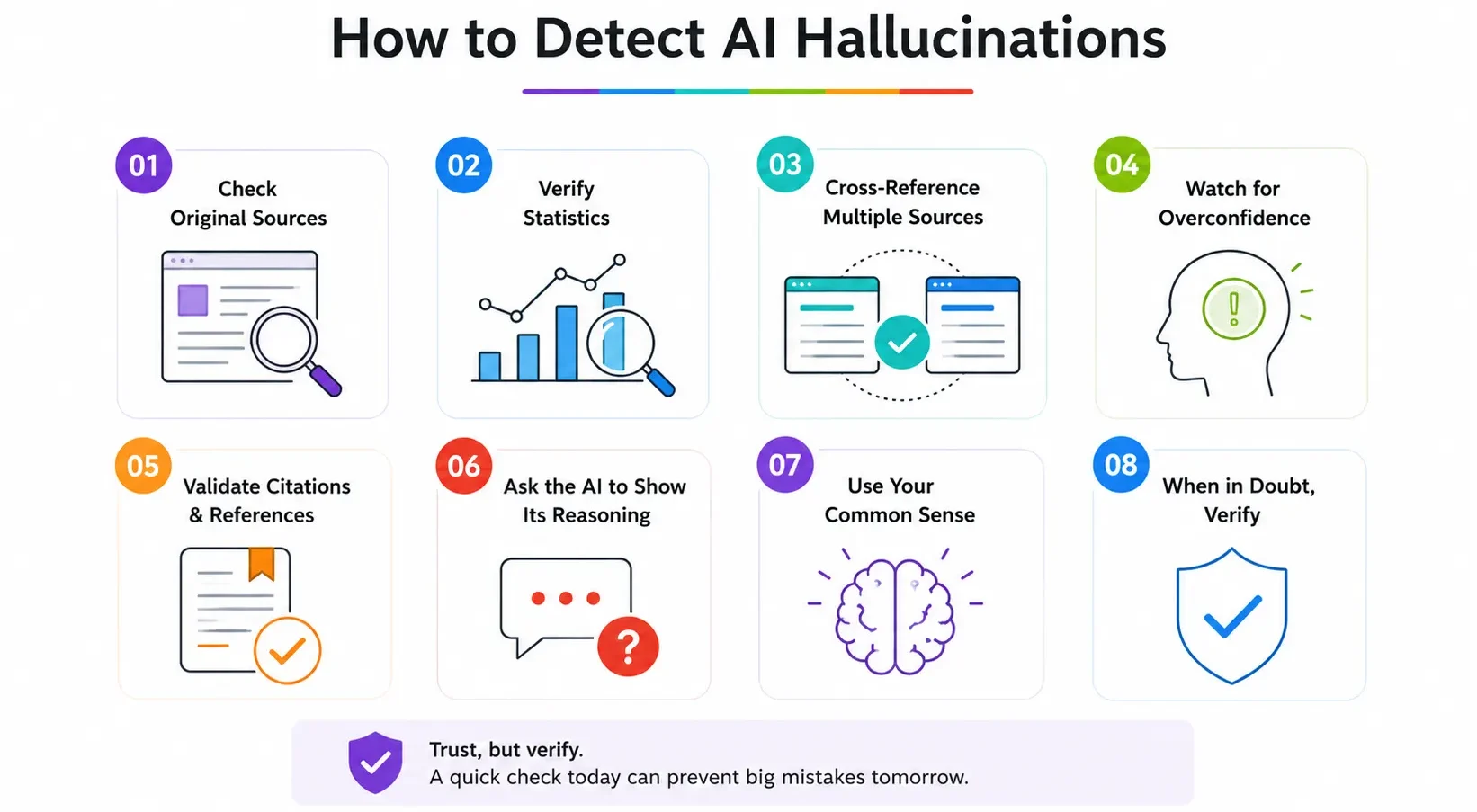
Knowing that hallucinations exist is useful. Knowing how to detect AI hallucinations is what actually protects you from them.
The challenge is that hallucinations rarely announce themselves. AI doesn’t usually say, “I’m guessing here.” Instead, it presents information with confidence, whether the answer is correct or not.
Check the Original Sources
One of the fastest ways to identify an AI hallucination is to verify the source material. If an AI references a study, report, court case, industry survey, or academic paper, take a moment to confirm that it actually exists. Search reputable databases, official websites, or trusted publications.
Many cases of AI hallucination detection begin with a simple source check. If the source cannot be found anywhere, that’s an immediate red flag.
Verify Statistics and Numbers
Humans tend to trust numbers. After all, a precise statistic feels credible. AI systems know this and frequently generate percentages, market figures, growth rates, and survey results that appear realistic. The problem is that some of these figures may be inaccurate, outdated, or entirely fabricated.
Whenever statistics influence a business decision, verify them through original reports rather than relying solely on AI-generated summaries. This step is particularly important when evaluating market research, financial forecasts, or competitive intelligence.
Cross-Reference Multiple Sources
Never trust a critical fact from a single AI response. Instead, compare information across multiple authoritative sources. If a claim appears only in the AI-generated answer and nowhere else, it deserves further investigation.
This approach helps reduce the risk of both AI false information and AI-generated misinformation finding its way into reports, articles, presentations, or strategic decisions.
Watch for Overconfidence
One of the most common signs of AI hallucination is excessive certainty. Experts typically acknowledge uncertainty when discussing complex topics. They mention limitations, conflicting evidence, or areas where more research is needed.
Hallucinated content often does the opposite. It presents information as an absolute fact without nuance or supporting evidence. Ironically, the more confident a claim sounds, the more carefully it should be checked.
Validate Citations and References
Many hallucinations hide inside citations. When reviewing AI-generated content, pay close attention to:
- Author names
- Publication titles
- Journal references
- URLs
- Publication dates
If any of these details seem unusual, verify them independently. This is one of the most effective methods for hallucination detection in LLMs, particularly when using AI for academic research, legal work, technical documentation, or long-form content creation.
Ask the AI to Show Its Reasoning
Sometimes a second prompt can reveal weaknesses in the original answer. Ask questions such as:
- What sources support this claim?
- How confident are you in this response?
- Can you provide evidence for this statistic?
- What are alternative viewpoints?
While this won’t eliminate hallucinations, it often exposes unsupported claims that might otherwise go unnoticed.
A Simple Reality Check Goes a Long Way
Perhaps the most underrated technique is also the simplest. Pause and ask yourself: “Does this actually make sense?” If a statistic seems unusually high, a citation looks unfamiliar, or a claim sounds too perfect, trust your instincts and investigate further.
Effective AI hallucination detection isn’t about distrusting AI. It’s about treating AI-generated information the same way experienced professionals treat any source of information with healthy scepticism and careful verification.
The good news is that spotting hallucinations becomes easier with practice. And once you’ve identified potential issues, the next step is making sure AI-generated content is properly verified before it’s published, shared, or used for decision-making.
How to Verify AI-Generated Content Before Publishing
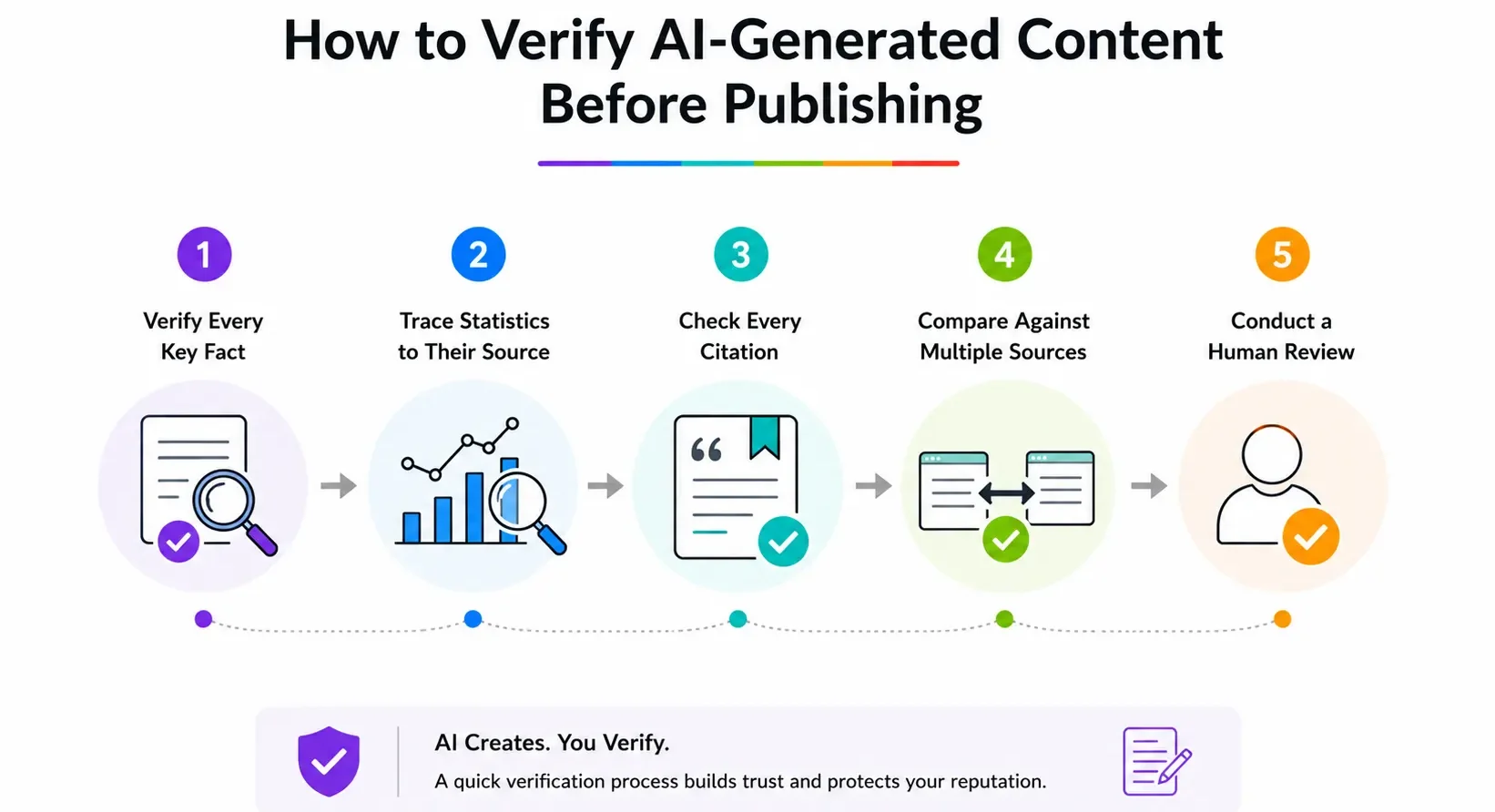
Spotting potential hallucinations is important. But for businesses, marketers, researchers, and content creators, detection is only half the battle. The real goal is ensuring that AI-generated content is accurate before it reaches customers, stakeholders, or the public, especially as organisations focus more on controlling the reliability and accuracy of generative AI outputs.
That’s where a structured approach to verifying AI-generated content becomes invaluable. Think of AI as an incredibly fast first draft creator. It can gather ideas, organise information, and produce content in seconds. What it can’t always do is guarantee factual accuracy. That’s still a human responsibility.
A Practical 5-Step AI Output Verification Framework
Rather than checking content randomly, follow a consistent process.
1. Verify Every Key Fact
Start by reviewing any factual claims, dates, names, locations, regulations, or historical references. If a statement influences a business decision or supports an important argument, verify it through trusted primary sources. This simple habit prevents many cases of AI false information from slipping through unnoticed.
2. Trace Statistics Back to Their Source
Statistics often carry the most authority and the most risk. If AI cites market growth figures, customer behaviour trends, survey data, or industry benchmarks, locate the original report before using the information. A surprising number of hallucinations involve numbers that sound reasonable but lack any legitimate source.
3. Check Every Citation
Whether you’re creating a research article, white paper, blog post, or business report, citations deserve special attention. Confirm that:
- The source exists
- The author is real
- The publication is legitimate
- The information supports the claim being made
This step helps eliminate AI citation errors and fabricated references before publication.
4. Compare Against Multiple Trusted Sources
A single source, even a reputable one, may contain outdated information. Cross-referencing information across industry reports, government publications, academic research, and trusted news organisations creates a stronger foundation for accuracy. This is one of the most effective defences against AI-generated misinformation.
5. Conduct a Human Review
No matter how advanced AI becomes, human judgment remains essential. An experienced reviewer can identify inconsistencies, contextual errors, exaggerated claims, and logical gaps that automated systems may overlook.
Many organisations now require human approval before AI-generated content is published externally. That extra review step may add a few minutes to the process, but it can prevent costly mistakes later.
Verification Is Becoming a Competitive Advantage
A few years ago, speed was the primary selling point of AI. Today, accuracy is becoming just as important. Businesses that establish strong AI output verification processes are often able to publish content faster than competitors while maintaining credibility and trust.
And trust matters. A single hallucinated statistic or fabricated source can undermine an otherwise excellent piece of content. The good news is that most hallucinations can be caught through careful review. Better yet, many can be prevented before they happen in the first place.
How to Prevent AI Hallucinations
If you’ve made it this far, one thing is probably clear: AI hallucinations aren’t going away anytime soon.
The encouraging news is that while it’s impossible to eliminate them, it’s absolutely possible to reduce their frequency and impact. In fact, many organisations have already developed effective methods for reducing hallucinations in generative AI without sacrificing productivity.
Write Better Prompts
The effectiveness of this approach is closely tied to the principles of prompt engineering, where better instructions often lead to more accurate and reliable AI responses.
Surprisingly, many hallucinations begin with vague instructions. A prompt like “Give me statistics about AI adoption” leaves a lot of room for interpretation. Which industry? Which country? What timeframe?
A more specific request, such as “Provide AI adoption statistics from Gartner or McKinsey published after 2024”, gives the model clearer boundaries. The more context you provide, the less likely the AI is to fill information gaps with assumptions.
Ask for Sources Up Front
One simple technique that many experienced AI users rely on is requesting sources as part of the original prompt. For example:
“Provide your answer and include the source for every statistic.”
This won’t guarantee accuracy, but it often encourages better responses and makes verification easier. When sources are missing or difficult to verify, that’s often an early warning sign that additional fact-checking is needed.
Use Retrieval-Augmented Generation (RAG)
Many businesses are now combining large language models with internal databases, knowledge bases, and verified information sources. This approach, commonly called Retrieval-Augmented Generation (RAG), allows AI systems to reference approved data rather than relying solely on training information.
As a result, organisations can significantly improve accuracy while reducing the likelihood of hallucinated content. It’s one reason enterprise AI deployments often perform differently from public consumer chatbots.
Keep Humans in the Loop
Technology is improving rapidly, but human expertise still plays a critical role. Whether you’re creating content, conducting research, generating reports, or analysing customer data, human review remains one of the most reliable safeguards against hallucinations.
The goal isn’t to replace human judgment. It’s to amplify it. Organisations that achieve the best results typically use AI for speed and efficiency while relying on people for validation and final decision-making.
Establish AI Governance Policies
As AI adoption grows, businesses are paying closer attention to enterprise AI hallucination risks. Forward-thinking organisations are creating internal guidelines that define:
- When AI can be used
- What information requires verification
- Which sources are considered trustworthy
- Who is responsible for final approval
These policies help create consistency and reduce the chance that inaccurate AI-generated information reaches customers or stakeholders.
Prevention Is Better Than Correction
A fabricated statistic in a blog post can damage credibility. An inaccurate report can influence business decisions. A false citation can undermine trust in an entire document. That’s why organisations increasingly view how to prevent AI hallucinations as a business process rather than a technical problem.
Better prompts, stronger verification systems, trusted data sources, and human oversight won’t eliminate every hallucination. But together, they can dramatically reduce the risk. And when the stakes involve revenue, compliance, reputation, or customer trust, that reduction can make a significant difference.
Are AI Hallucinations Dangerous for Businesses?
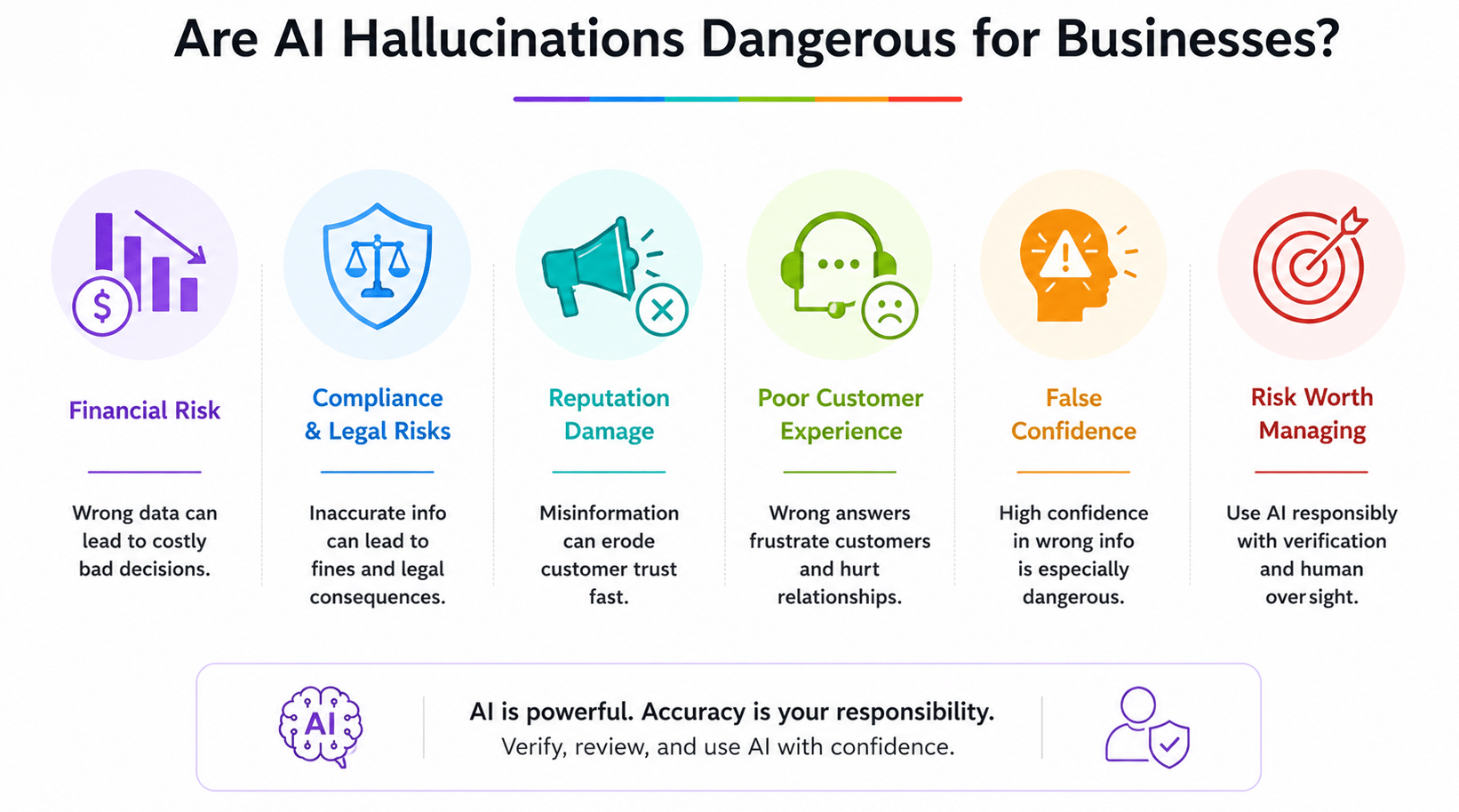
For casual tasks, an AI hallucination might be nothing more than an inconvenience. A wrong movie recommendation or an inaccurate trivia answer isn’t likely to cause major harm. Business environments are different.
When organisations use AI to create content, analyse data, generate reports, support customers, or inform strategic decisions, the consequences of inaccurate information can become much more serious. That’s why many leaders are asking: Are AI hallucinations dangerous?
The answer depends on how the technology is being used but the risks are real.
Financial Decisions Based on Incorrect Information
Imagine an AI-generated market analysis that includes fabricated growth statistics or inaccurate competitor data. If decision-makers accept that information without verification, the organisation may invest resources based on assumptions that were never true in the first place.
Compliance and Legal Risks
Financial services, healthcare organisations, insurance providers, and legal firms must comply with strict rules regarding accuracy, documentation, and reporting. A hallucinated fact, citation, or recommendation could create compliance concerns and expose organisations to legal consequences.
Reputation Can Be Lost Quickly
Trust takes years to build and minutes to damage. If a company publishes content containing AI-generated misinformation, inaccurate statistics, or fabricated references, customers may begin questioning the reliability of the brand itself.
In competitive markets, credibility is often one of a company’s most valuable assets. A single mistake won’t necessarily destroy that trust. Repeated mistakes can.
Customer Experience Suffers
Many organisations now use AI-powered chatbots to handle customer inquiries. When these systems provide incorrect information about products, pricing, policies, or services, customer frustration grows quickly. In some cases, misinformation can even lead to lost sales or support escalations.
This is where enterprise AI hallucination risks become especially visible. The technology may improve efficiency, but only if the information provided remains accurate.
The Hidden Risk: False Confidence
Perhaps the most significant danger isn’t the hallucination itself. It’s the confidence with which the hallucination is delivered. Humans naturally trust information that sounds authoritative. When AI presents inaccurate information in a polished and professional format, users may accept it without questioning the source.
That combination of high confidence and low accuracy creates a unique challenge that businesses must actively manage.
A Risk Worth Managing, Not Avoiding
The benefits of AI remain substantial. Businesses are using it to improve productivity, accelerate research, support customer service, and create content at a scale that would have been difficult just a few years ago.
The goal isn’t to eliminate AI from business processes. The goal is to use it responsibly. Organisations that understand AI risk management, implement verification procedures, and maintain human oversight can often capture the advantages of AI while minimising exposure to hallucination-related problems.
The final question, then, is whether technology will eventually solve this challenge completely or whether hallucinations will remain a permanent part of the AI landscape.
Can AI Hallucinations Be Eliminated Completely?
At least for now, the answer is no. Even the most advanced AI models occasionally generate incorrect information. Researchers continue to improve model accuracy, retrieval systems, reasoning capabilities, and fact-checking mechanisms, but no major large language model has achieved perfect reliability across every task and subject area.
Modern AI systems are significantly more accurate than earlier generations. New approaches such as Retrieval-Augmented Generation (RAG), real-time web access, specialised domain models, and improved training techniques are helping reduce hallucination rates year after year.
In many ways, AI should be viewed like any other business tool. Search engines can return inaccurate information. Human experts can make mistakes. Research reports can contain errors. AI is no different; it simply introduces a new type of accuracy challenge that requires thoughtful management.
So while AI hallucinations may never disappear entirely, their impact can be dramatically reduced through better models, stronger verification systems, trusted data sources, and human oversight.
The organisations that thrive in the AI era won’t be the ones that blindly trust AI outputs. They’ll be the ones who know when to trust, when to verify, and when to ask one more question.
Conclusion
An AI hallucination occurs when a model generates information that appears credible but is inaccurate, misleading, or entirely fabricated. From fake legal cases and fabricated citations to incorrect statistics and unsupported claims, hallucinations can affect virtually any industry that relies on AI-generated content.
By understanding why AI hallucinations happen, learning how to detect AI hallucinations, implementing strong AI output verification processes, and maintaining human oversight, organisations can significantly reduce the likelihood of costly mistakes.
The future isn’t about choosing between humans and AI. It’s about combining the speed and efficiency of AI with the judgment, experience, and critical thinking that only humans can provide. Those who strike that balance will be best positioned to benefit from AI while avoiding the pitfalls of artificial intelligence hallucinations.
FAQs
Hallucination rates vary between models and change frequently as vendors release updates. No major AI model is completely free from hallucinations. Some models perform better on factual accuracy, while others prioritise reasoning, creativity, or conversational abilities. Rather than focusing on a single model, users should assume that any AI system can occasionally generate incorrect information.
Researchers continue to improve AI accuracy through better training methods, retrieval systems, fact-checking mechanisms, and reasoning models. However, most experts believe hallucinations cannot be completely eliminated in current large language model architectures. The goal is to reduce hallucinations to a level where they can be managed through verification and human oversight.
One of AI’s biggest weaknesses is its inability to consistently distinguish between factual information and statistically likely language patterns. AI can generate fluent, persuasive responses even when it lacks accurate information. This gap between confidence and accuracy is the root cause of many AI hallucinations.
Yes. One of the most common forms of AI hallucination is the creation of fabricated references. AI may generate realistic-looking paper titles, author names, publication dates, and journal citations that do not actually exist. Researchers and students should always verify sources independently.
Yes. When hallucinated information is shared, published, or repeated without verification, it can contribute to misinformation. This is one reason why responsible AI use requires human review and fact-checking.
Some modern AI systems can identify uncertainty better than earlier models, but they are not fully reliable at detecting their own hallucinations. External verification and human judgment remain more dependable methods.