

Artificial intelligence has moved beyond from just being a concept. Now it’s helping businesses to write content, forecast sales, detect fraud, personalise customer experiences, and even generate software code. Yet despite the rapid adoption of AI, many people still confuse two of its most important branches: Generative AI and Predictive AI.
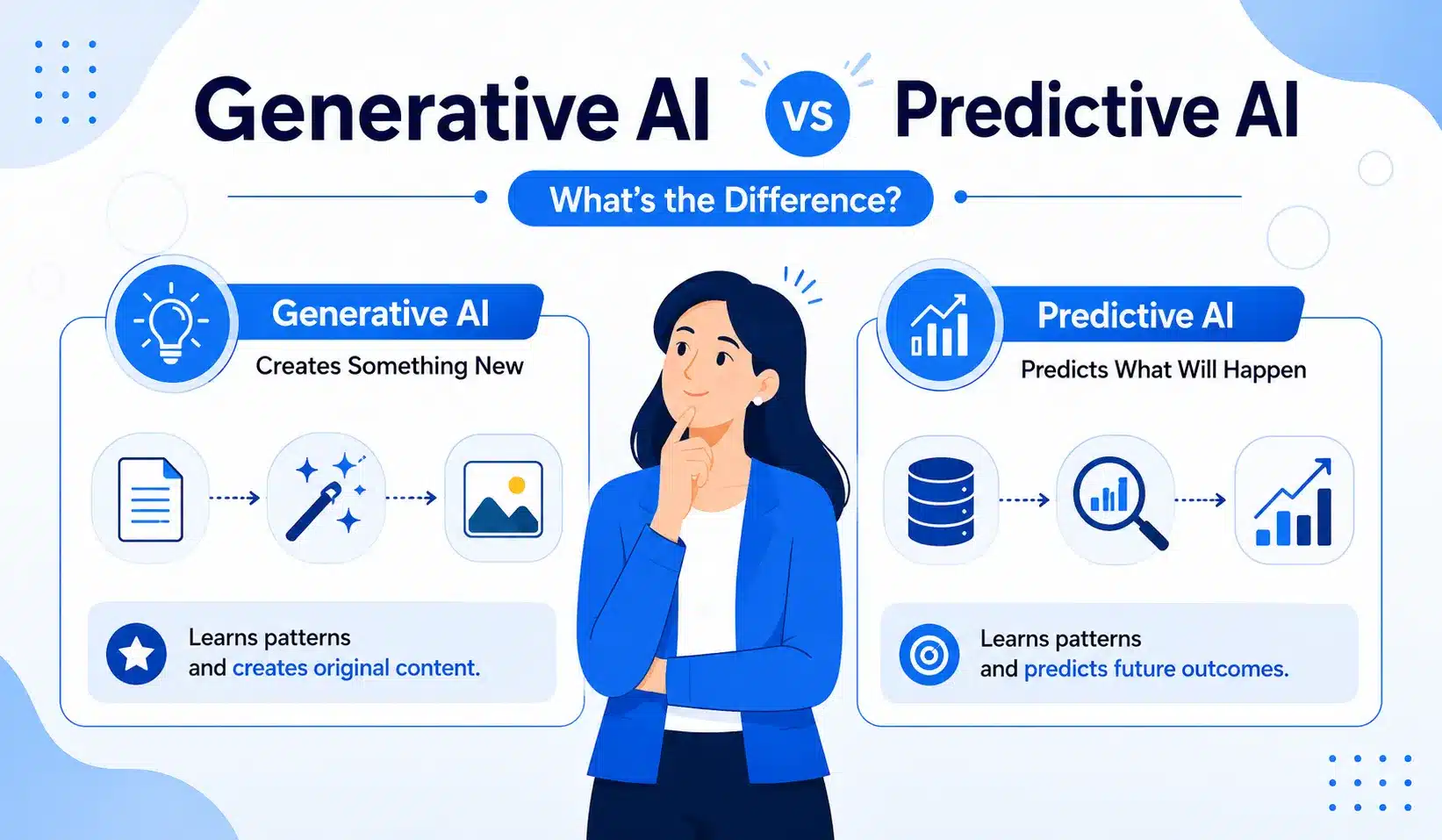
Generative AI focuses on creating something new. It can produce text, images, videos, music, and even computer code based on patterns learned from existing data. On the other hand, Predictive AI can analyse historical information to forecast what is likely to happen next. Think like one as a creator and the other as a forecaster.
So the difference between generative AI and predictive AI is becoming important for businesses. According to McKinsey, nearly 78% of organisations now use AI in at least one business function, while Generative AI adoption continues to grow across marketing, customer service, and software development teams.
What Is Generative AI?
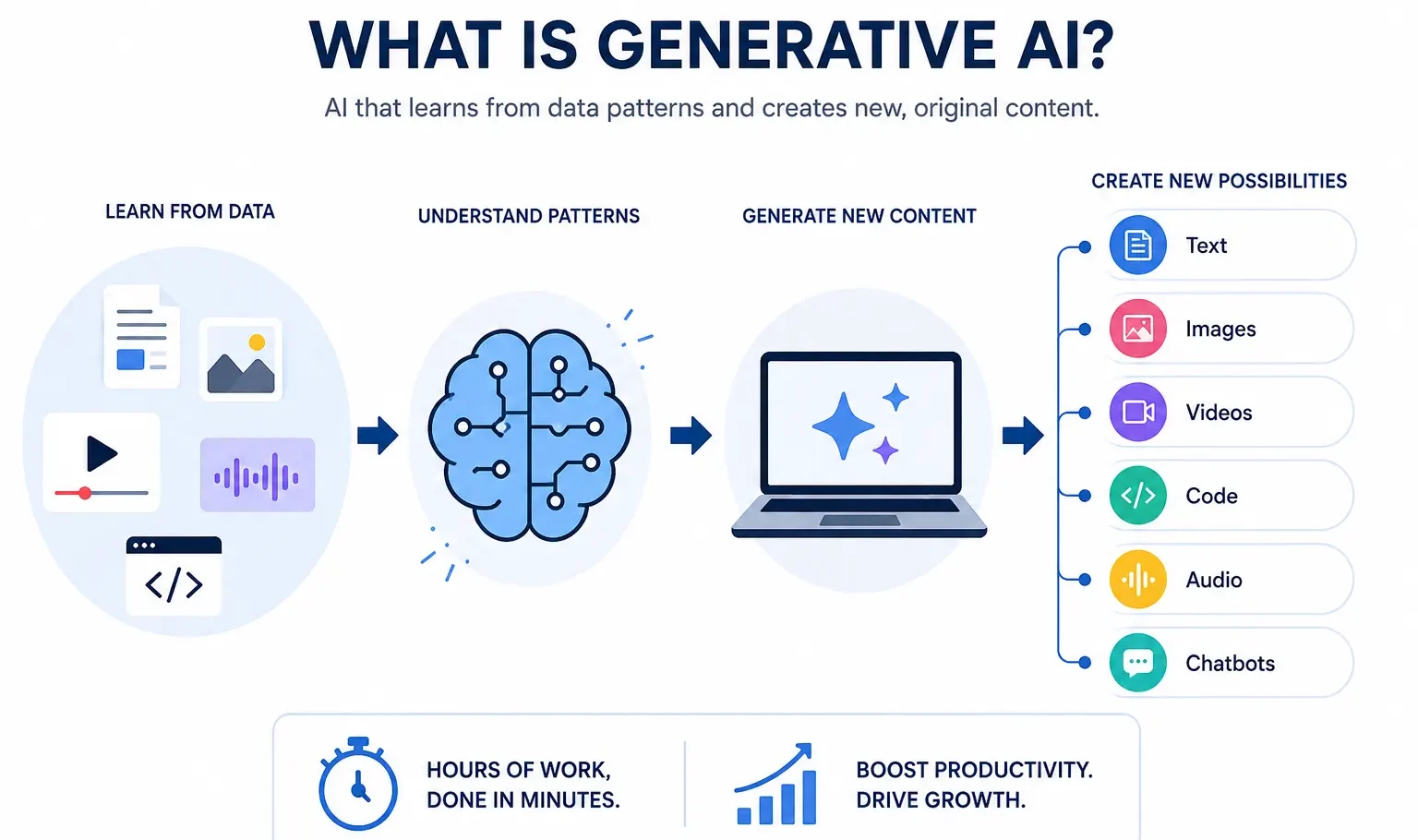
Generative artificial intelligence is an type of AI that can create new content by learning patterns from big datasets. Instead of simply identifying trends or making predictions, it produces original outputs that resemble the data it was trained on. Outputs like articles, social media posts, images, videos, software code, audio files, and much more.
The recent explosion of interest in generative AI can largely because of tools like ChatGPT, Gemini, Claude, Midjourney, and DALL-E. Generative AI studies vast amounts of data, identifies patterns, relationships, and structures, and then uses that knowledge to generate fresh content.
The quality of AI-generated output often depends on how effectively prompts are written, which is why prompt engineering has become an important skill when working with modern AI systems.
Some common generative AI examples include:
- Writing blog articles and website copy
- Creating social media captions
- Generating product descriptions for e-commerce stores
- Producing marketing emails
- Designing images and graphics
- Assisting developers with code generation
- Creating chatbot conversations
For businesses, tasks that once took hours can now be completed in just minutes. A recent Goldman Sachs report says that generative AI could increase global productivity significantly over the coming decade by automating content-heavy and repetitive knowledge work.
But despite this, it’s important to note that Generative AI isn’t predicting the future. It’s generating content based on its learned patterns. And that’s why the distinction between generative AI and predictive AI begins to emerge.
How Generative AI Works
Generative AI systems are trained using enormous datasets that can contain billions of words, images, videos, or code snippets. During training, the model learns relationships within that data. It starts recognising patterns, context, sequences, and probabilities.
For example, when ChatGPT generates a sentence, it isn’t searching a database for a pre-written answer. Instead, it predicts which words are most likely to come next based on everything it has learned during training.
That’s why modern content generation AI tools can produce content that feels remarkably human. They’re constantly evaluating context and generating responses one piece at a time.
What Is Predictive AI?
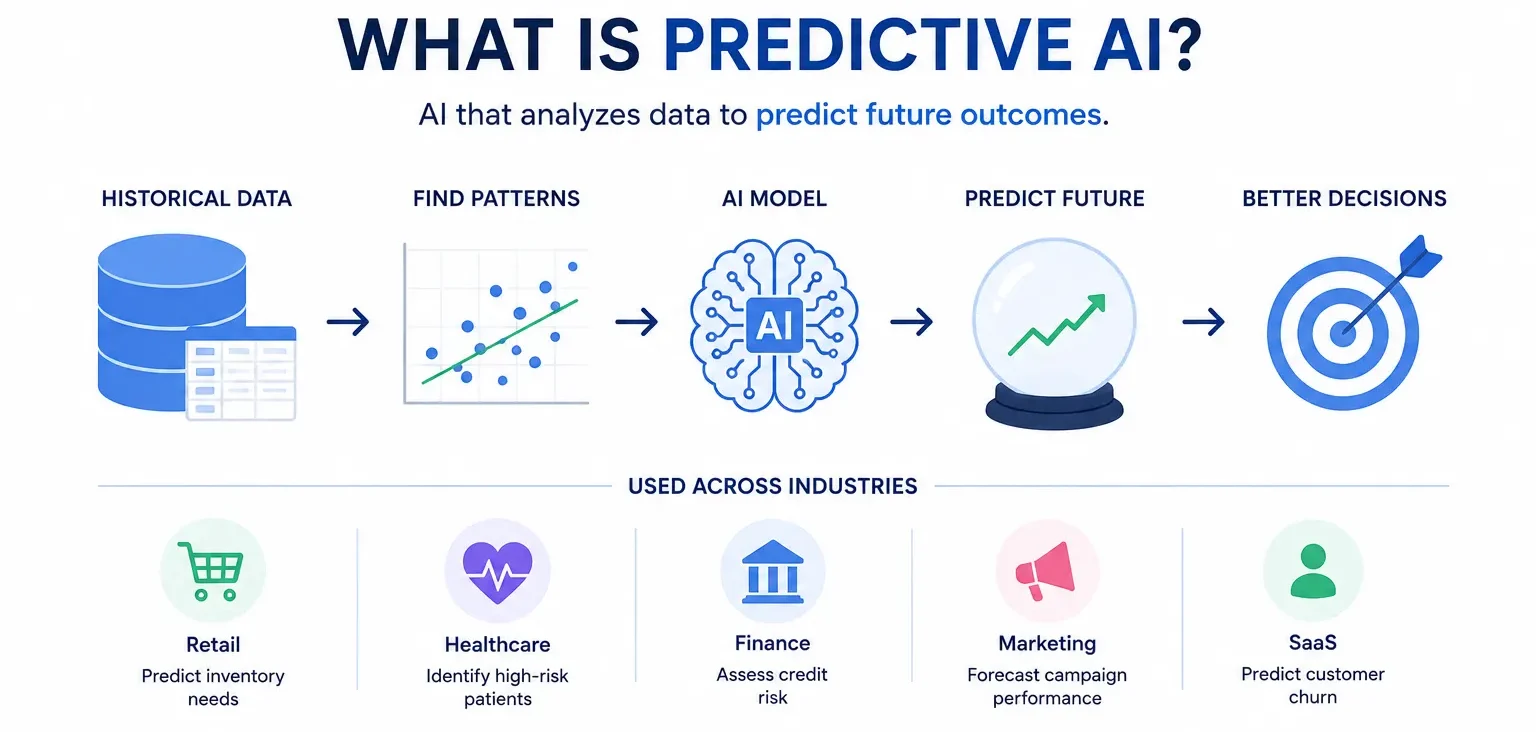
Predictive AI uses historical data, statistical techniques, and machine learning algorithms to estimate future outcomes. Instead of generating new content, it identifies patterns in existing data and uses those patterns to predict what is likely to happen next.
When Netflix recommends a show you might enjoy, that’s Predictive AI. And, Amazon suggests products based on your browsing history, that’s Predictive AI. Also, your bank flags a suspicious transaction before fraud occurs. Predictive AI is working behind the scenes.
In fact, predictive analytics has been a core business technology for years, long before Generative AI became a mainstream topic. The goal is straightforward: help organisations make better decisions using data.
Imagine a retail company trying to estimate demand during the holiday season. Rather than relying on intuition, Predictive AI analyses historical sales patterns, customer behaviour, economic factors, and seasonal trends to forecast future demand.
The same principle applies across industries:
- Retailers predict inventory requirements.
- Healthcare providers identify patients at higher risk of complications.
- Financial institutions assess creditworthiness.
- Marketing teams forecast campaign performance.
- SaaS companies predict customer churn.
According to research from Fortune Business Insights, the global predictive analytics market is expected to exceed $95 billion by the early 2030s as organisations increasingly rely on data-driven decision-making.
Unlike Generative AI, which focuses on creation, Predictive AI focuses on probability. It answers questions such as:
- Which customers are likely to make a purchase?
- Which leads are most likely to convert?
- Which products will sell next month?
- Which customers may cancel their subscriptions?
These insights help businesses allocate resources more effectively and reduce uncertainty when making important decisions.
How Predictive AI Works
Although Generative AI and Predictive AI both rely on machine learning, the way they operate is quite different. Predictive AI starts with historical data. Lots of it.
The system examines past events, customer actions, sales figures, transactions, or operational records and searches for recurring patterns. Once those patterns are identified, the AI builds models capable of estimating future outcomes.
For example, an eCommerce company may have years of purchase data showing that customers who buy a smartphone often purchase accessories within two weeks. The model recognises this pattern and predicts which customers are most likely to make those additional purchases.
A sales manager, for instance, may receive a report showing that a particular lead has an 85% chance of converting. A logistics company may receive a forecast indicating increased product demand in a specific region.
Generative AI vs Predictive AI: Key Difference
Both technologies use machine learning. And rely on data. Plus, it can improve business outcomes. Yet their objectives are fundamentally different. One team studies weather patterns and predicts tomorrow’s temperature. Another team writes the weather report you’ll read on your phone.
The first is acting like Predictive AI. The second is acting like Generative AI. Here’s the comparison:
| Factor | Generative AI | Predictive AI |
| Primary Goal | Creates new content | Predicts future outcomes |
| Output | Text, images, videos, code | Forecasts, recommendations, probability scores |
| Data Usage | Learns patterns to generate content | Learns patterns to forecast behaviour |
| Business Focus | Creativity and automation | Decision-making and forecasting |
| Common Examples | ChatGPT, Claude, Midjourney | Salesforce Einstein, fraud detection systems |
| Typical Users | Content teams, marketers, developers | Analysts, sales teams, operations managers |
The biggest distinction comes down to the final output. This is why discussions around predictive AI vs generative AI shouldn’t focus on which technology is “better.”
A content marketing agency may gain enormous value from Generative AI because content production is central to its operations. A financial institution, meanwhile, may depend more heavily on Predictive AI to assess risk and detect suspicious activity.
For example, an online retailer could use Predictive AI to identify customers most likely to make a purchase during the next 30 days. Once those customers are identified, Generative AI can create personalised email campaigns tailored to each audience segment.
So Which AI Is More Valuable?
A few years ago, Predictive AI was the star of the show. Businesses invested heavily in predictive analytics because forecasting customer behaviour offered a clear competitive advantage. Then Generative AI arrived and changed the conversation almost overnight.
Suddenly, companies start automating content creation, customer interactions, coding assistance, and creative tasks at a scale that seemed impossible just a few years earlier. Yet despite all the attention surrounding Generative AI, businesses still rely heavily on predictive analytics for critical decisions.
After all, generating a beautiful marketing campaign is useful. Knowing which audience is most likely to convert is equally important. That’s why many industry experts see these technologies as complementary rather than competing.
Generative AI vs Traditional AI: What’s Changed?
For decades, most AI systems were designed to analyse information, classify data, or automate specific tasks. These systems are often referred to as traditional AI.
It powers recommendation engines, fraud detection systems, search algorithms, voice assistants, and predictive analytics platforms. However, its capabilities are generally limited to the tasks it was trained to perform.
Unlike traditional systems that focus primarily on recognising patterns or making classifications, Generative AI creates entirely new outputs from what it has learned.
Imagine teaching two employees about marketing. The first employee studies customer behaviour and predicts which campaign will perform best. The second employee writes the campaign itself.
Both are valuable, but their responsibilities are very different. This comparison highlights the distinction between generative AI and traditional AI.
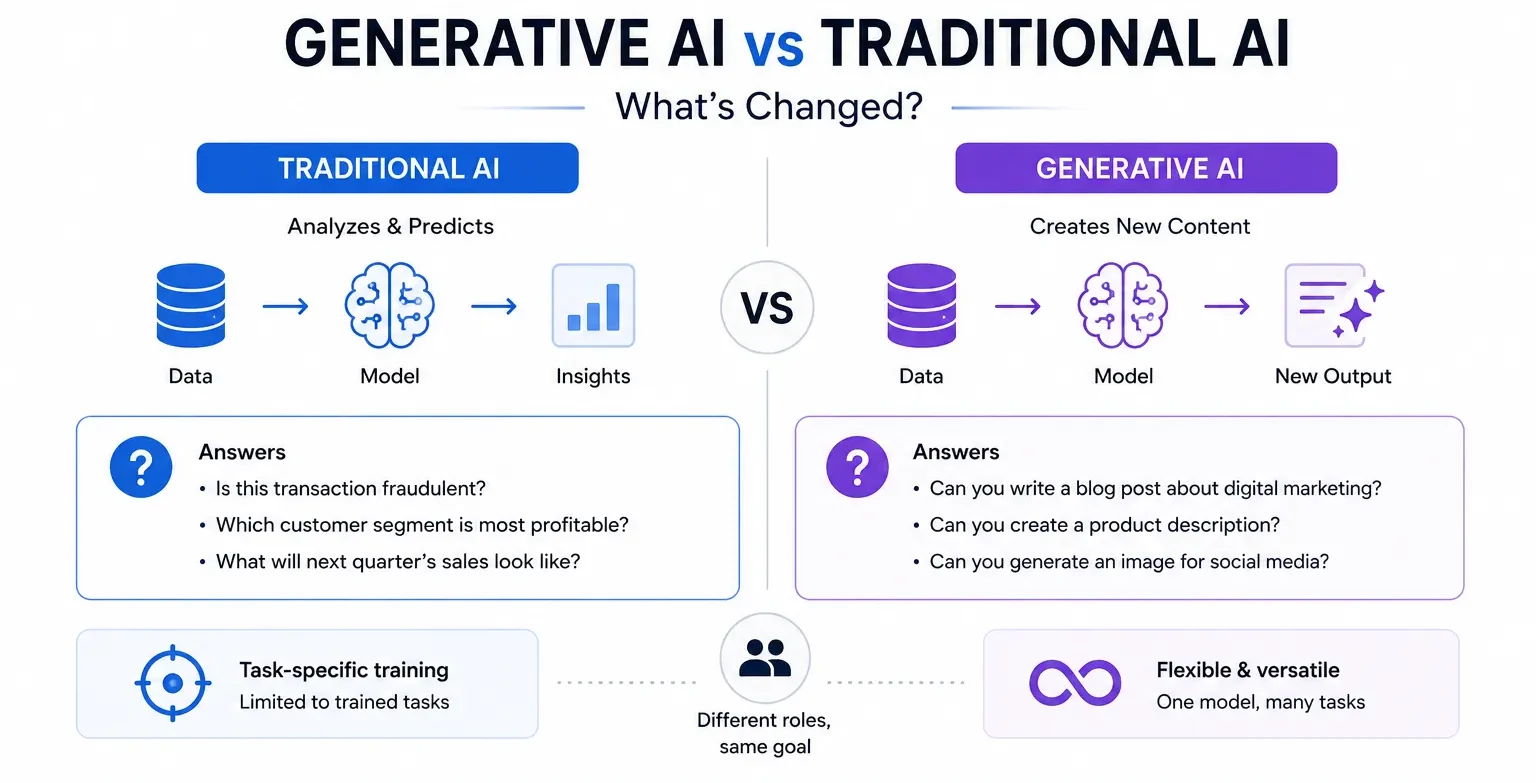
Traditional AI answers questions such as:
- Is this transaction fraudulent?
- Which customer segment is most profitable?
- What will next quarter’s sales look like?
Generative AI answers different questions:
- Can you write a blog post about digital marketing?
- Can you create a product description?
- Can you generate an image for a social media campaign?
Traditional AI models often require task-specific training. Generative AI models, particularly large language models, can perform a wide range of tasks using the same underlying system.
This flexibility has fueled discussions around machine learning vs generative AI. While Generative AI is built on machine learning techniques, it represents a significant evolution in how AI systems interact with users and create outputs.
According to Deloitte, organisations are increasingly investing in Generative AI because it offers opportunities to automate creative and knowledge-based work that was once considered uniquely human. Traditional AI, Predictive AI, and Generative AI are increasingly working together within modern organisations. One analysis. One predicts. One creates.
Real-World Examples of Generative AI and Predictive AI
Most people use both Generative AI and Predictive AI every day without realising it.
Generative AI Examples
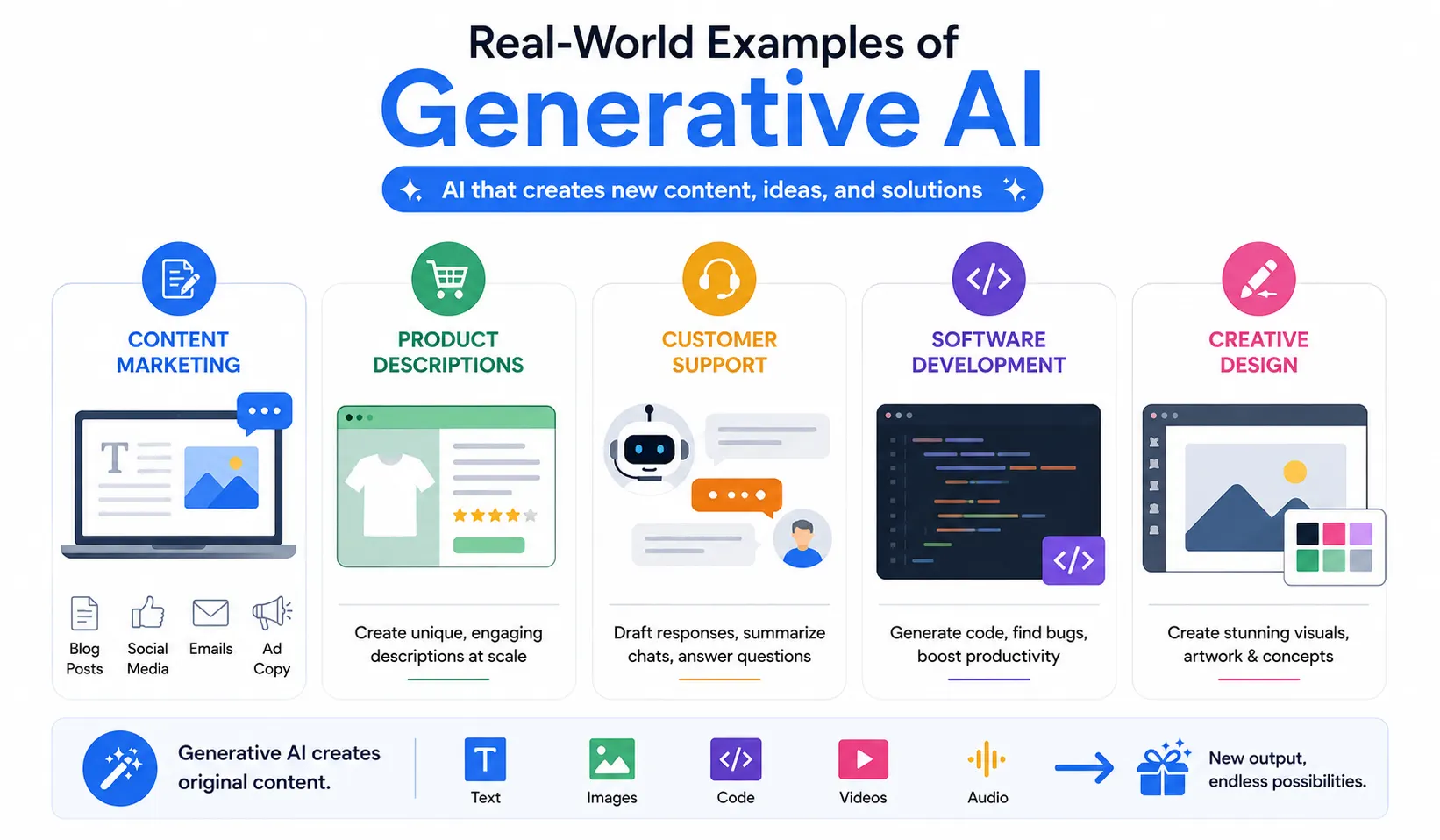
When people hear the term generative AI examples, tools like ChatGPT often come to mind first. But the technology extends far beyond chatbots. Today, businesses use Generative AI to create content, automate workflows, and support creative teams at scale.
Some common real-world examples of Generative AI include:
Content Marketing
A digital marketing agency can generate blog outlines, social media posts, email campaigns, and ad copy in minutes rather than hours. This is one reason generative AI for content creation has become so popular among marketers.
Product Descriptions
Large eCommerce brands often manage thousands of products. Generative AI helps create unique product descriptions quickly while maintaining brand consistency.
Customer Support
AI-powered assistants can draft responses, summarise conversations, and answer routine customer questions around the clock.
Software Development
Developers use tools such as GitHub Copilot to generate code snippets, identify bugs, and speed up software development.
Creative Design
Platforms like Midjourney and Adobe Firefly help designers create concepts, illustrations, and visual assets from simple prompts.
What’s important to remember is that Generative AI creates something new. Whether it’s text, images, code, or video, the output didn’t previously exist.
Predictive AI Examples
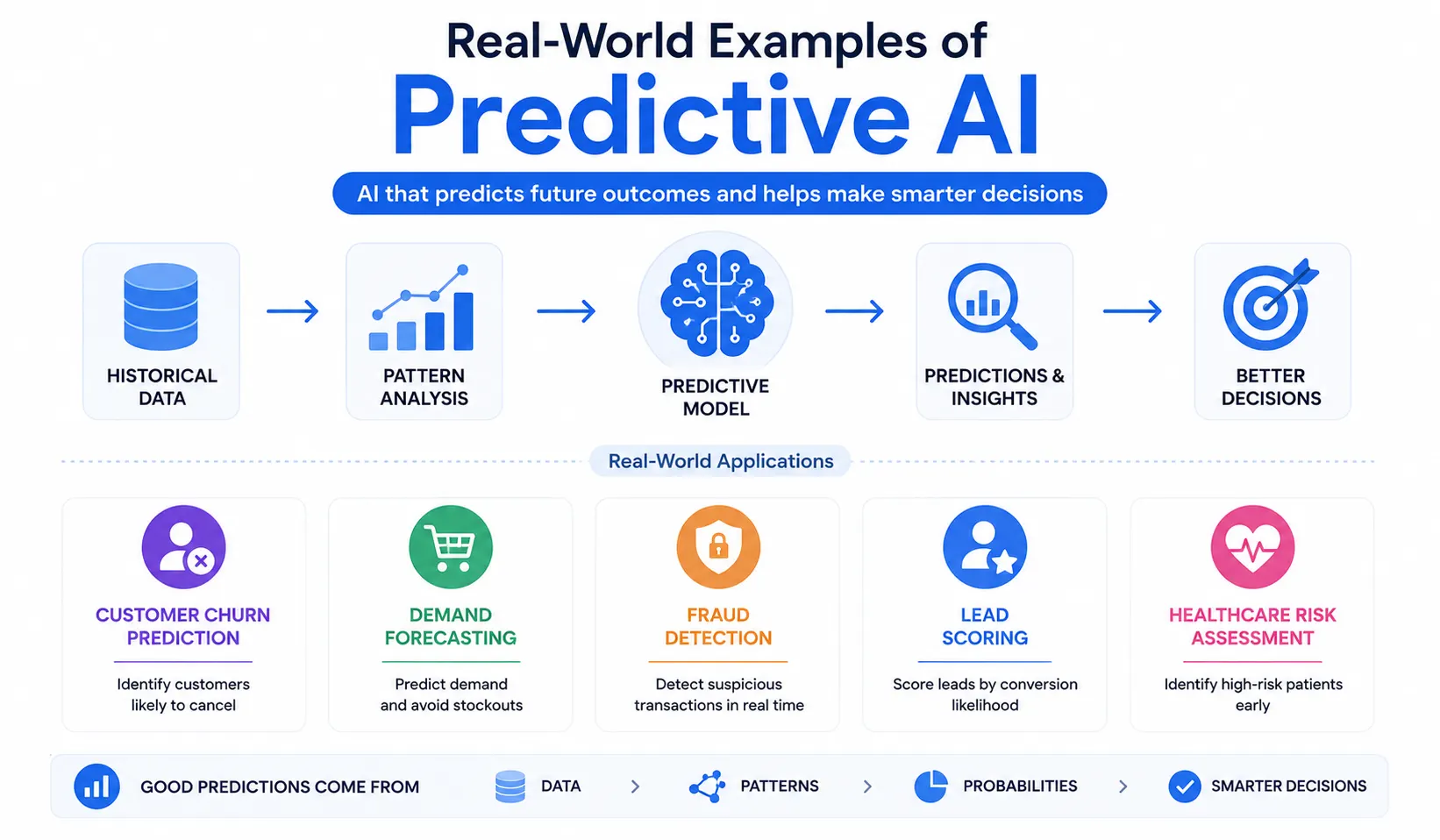
Many of the systems we rely on daily are powered by predictive analytics and predictive machine learning models.
Some notable predictive AI examples include:
Customer Churn Prediction
Subscription businesses use Predictive AI to identify customers who may cancel their plans. This allows teams to intervene before revenue is lost.
Demand Forecasting
Retailers analyse historical purchasing patterns to predict future demand and avoid stock shortages.
Fraud Detection
Banks and payment providers use AI prediction models to detect unusual transaction behaviour in real time.
Lead Scoring
Sales teams prioritise prospects based on the likelihood of conversion, helping them focus on the opportunities most likely to generate revenue.
Healthcare Risk Assessment
Hospitals use predictive analytics to identify patients who may require additional care or monitoring.
A good prediction isn’t magic. It’s data, patterns, and probabilities working together. And while these applications may seem unrelated, they share a common purpose: helping organisations make smarter decisions before events occur.
Generative AI and Predictive AI Use Cases in Business
Here’s where things get particularly interesting for business leaders. Many articles compare these technologies as if companies must choose one or the other. In reality, the most successful organisations often use both.
Generative AI for Business
The rapid rise of generative AI for business has been driven by one simple factor: efficiency. Content creation, documentation, customer communication, and knowledge management require significant time and resources. Generative AI helps reduce that workload.
For example, a marketing team can generate first drafts of landing pages in minutes, allowing writers to focus on refining messaging rather than starting from a blank page. This is one reason many organisations are investing in enterprise AI solutions that incorporate generative capabilities.
Predictive AI for Business
Businesses generate enormous amounts of data every day. Hidden within that data are patterns that reveal opportunities, risks, and customer behaviour. These predictive analytics use cases help organisations allocate resources more effectively and reduce uncertainty.
A retailer, for instance, might use Predictive AI to forecast seasonal demand. Rather than guessing which products will sell, managers can make inventory decisions based on data-driven predictions.
When Generative AI and Predictive AI Work Together
The future isn’t Generative AI replacing Predictive AI. The future is collaboration between the two. Imagine a SaaS company trying to reduce customer churn.
First, Predictive AI identifies customers who are likely to cancel their subscriptions within the next 30 days. Then, Generative AI automatically creates personalised retention emails tailored to each customer’s behaviour and purchase history.
The prediction comes from Predictive AI. The communication comes from Generative AI. This combination improves efficiency while supporting stronger AI decision-making across the organisation.
For many companies, especially those pursuing digital transformation initiatives, the most effective strategy isn’t choosing between Generative AI and Predictive AI. It’s using both technologies where they make the greatest impact.
Generative AI and Predictive AI in Digital Marketing
If there’s one industry that has embraced AI faster than most, it’s digital marketing. Marketers have always been under pressure to do more with less, create more content, launch more campaigns, personalise customer experiences, and improve ROI. AI is helping bridge that gap.
What’s fascinating is that generative AI in digital marketing and predictive AI in digital marketing solve different challenges, yet they often work together behind the scenes.
How Generative AI Is Changing Marketing
For years, content creation was one of the biggest bottlenecks in marketing. Writing blog posts, creating social media content, producing email campaigns, and drafting ad copy all required significant time and resources. Today, generative AI applications in marketing are helping teams accelerate these processes.
Many marketing teams are also combining AI with social media automation tools to manage publishing schedules and streamline campaign execution. This doesn’t mean human creativity is disappearing. Far from it. The best marketing teams use Generative AI as a productivity tool rather than a replacement for strategy. The AI handles the first draft; humans provide the direction, brand voice, and critical thinking.
A useful analogy is GPS navigation. GPS doesn’t decide where you’re going; it simply helps you get there faster. Generative AI plays a similar role in content creation.
How Predictive AI Improves Marketing Performance
Creating content is only half the challenge. The bigger question is whether that content will perform. This is where predictive AI applications in marketing become valuable. Predictive AI helps marketers understand future customer behaviour by analysing historical data and identifying patterns.
Common marketing applications include:
- Predicting customer lifetime value
- Lead scoring
- Audience segmentation
- Campaign performance forecasting
- Conversion probability analysis
- Churn prediction
- Product recommendation engines
For example, instead of sending an email campaign to every customer, Predictive AI can identify which customers are most likely to engage, purchase, or unsubscribe. That level of insight can dramatically improve marketing efficiency. These insights become even more valuable when combined with SEO data and performance metrics from specialised marketing platforms.
According to research from Salesforce, marketers who use AI-driven insights often report higher campaign effectiveness and stronger personalisation capabilities compared to traditional approaches.
The Future of Marketing: Prediction Meets Creation
Here’s where things become really powerful. Imagine running a paid advertising campaign. Predictive AI analyses customer data and identifies the audience segments most likely to convert.
Generative AI then creates tailored ad copy, headlines, and landing page messaging for each audience segment. The result? More relevant content and better targeting.
One technology predicts who should receive the message. The other creates the message itself. This combination is becoming increasingly common across SEO, email marketing, customer relationship management, and performance advertising.
For agencies, eCommerce brands, and growing businesses, the ability to combine forecasting with content creation may become one of the biggest competitive advantages of the next decade.
Benefits of Generative AI vs Predictive AI
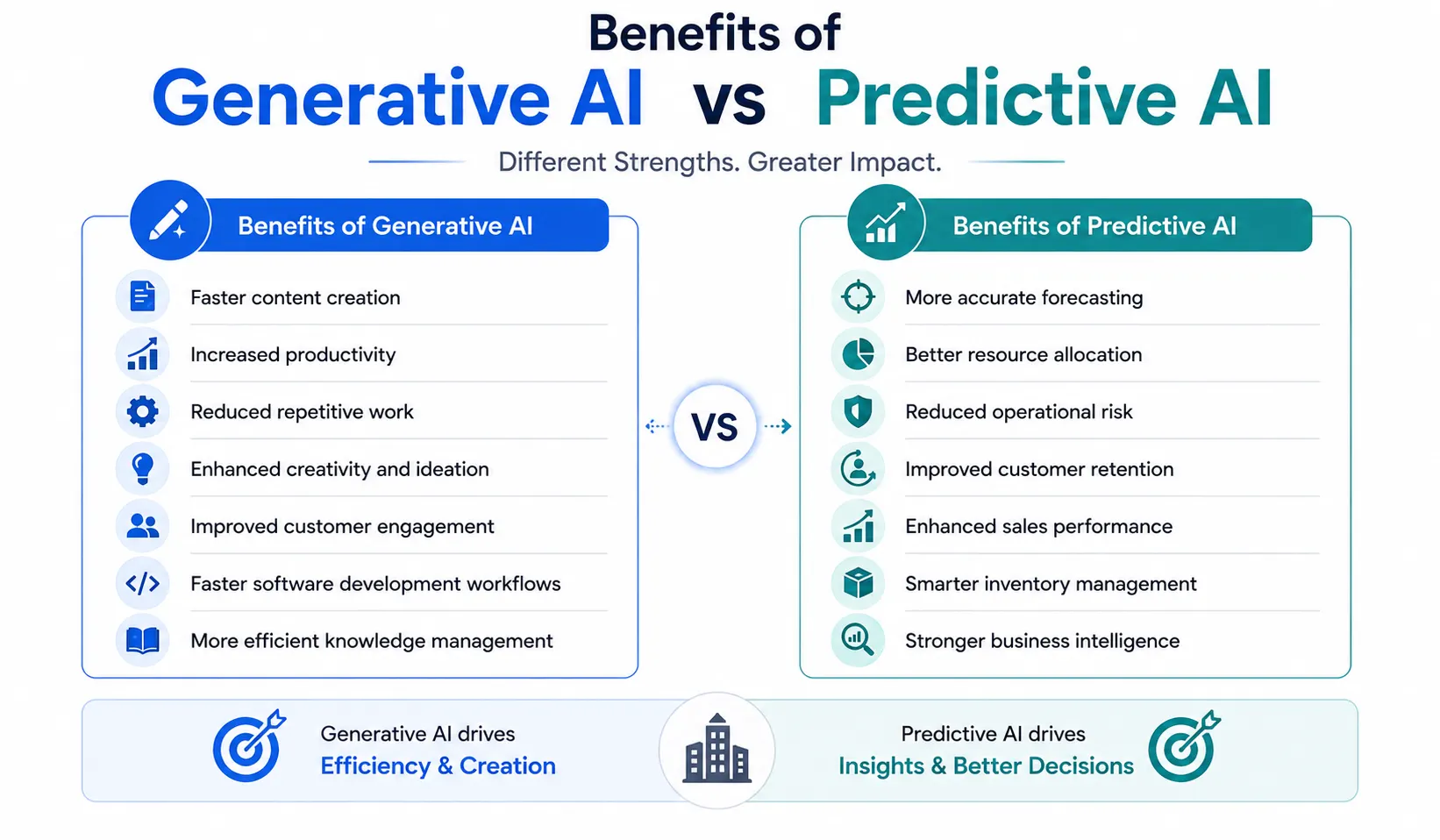
Both technologies offer significant benefits, but those benefits appear in different areas of the organisation.
Benefits of Generative AI
- Faster content creation
- Increased productivity
- Reduced repetitive work
- Enhanced creativity and ideation
- Improved customer engagement
- Faster software development workflows
- More efficient knowledge management
For marketing teams, this often translates into producing more content without proportionally increasing costs.
Benefits of Predictive AI
- More accurate forecasting
- Better resource allocation
- Reduced operational risk
- Improved customer retention
- Enhanced sales performance
- Smarter inventory management
- Stronger business intelligence
In many cases, Predictive AI directly influences revenue because it helps organisations focus on opportunities with the highest likelihood of success.
Future of Generative AI and Predictive AI
That may sound surprising given how much attention AI receives, but many organisations are only beginning to move beyond experimentation and into large-scale implementation.
The future of generative AI and predictive AI is unlikely to be defined by one technology replacing the other. Instead, we’ll see deeper integration between the two.
Several trends are already emerging:
Hyper-Personalization
Businesses will increasingly combine predictive insights with AI-generated experiences. Customer journeys, marketing campaigns, and product recommendations will become more personalised than ever before.
AI-Powered Decision Support
Executives won’t simply receive reports. AI systems will provide recommendations, generate summaries, and explain why certain decisions may be more effective.
Autonomous Business Workflows
Predictive AI will identify opportunities or risks, while Generative AI will automatically create responses, communications, or action plans.
Expansion of Enterprise AI Solutions
Large organisations are investing heavily in AI infrastructure as they seek competitive advantages through automation, forecasting, and customer experience improvements.
According to PwC, AI could contribute trillions of dollars to the global economy over the coming decade, making it one of the most significant technological shifts businesses have experienced since the rise of the internet.
The organisations that benefit most won’t necessarily be the ones with the most advanced technology.
Conclusion
Understanding the difference between generative AI and predictive AI is no longer just a technical discussion; it’s a business necessity.
Whether you’re exploring generative AI for business, evaluating predictive analytics use cases, or investing in enterprise AI solutions, the key is understanding which tool fits the task.
FAQs
ChatGPT is both. It is a Generative AI application powered by a Large Language Model (LLM). The LLM acts as the underlying model, while ChatGPT is the user-facing tool that generates conversational responses.
Yes. Many organisations combine both technologies. Predictive AI identifies future opportunities or risks, while Generative AI creates personalised content, reports, recommendations, or responses based on those insights.
Businesses should use Generative AI when they need to create content, automate communication, or assist creative workflows. Predictive AI is more suitable for forecasting demand, identifying trends, assessing risk, and improving strategic decision-making.
Yes. Predictive AI relies heavily on machine learning algorithms and statistical models to analyse historical data and estimate future outcomes, making it one of the most widely used applications of machine learning in business.
No. Predictive AI is designed to forecast outcomes, trends, and behaviours based on historical data. Content generation is a function of Generative AI, which creates text, images, code, audio, and other forms of content.
Generative AI learns by analysing massive datasets and identifying patterns, structures, and relationships within the data. It then uses deep learning models, such as transformers and large language models (LLMs), to generate new content that resembles its training data.