

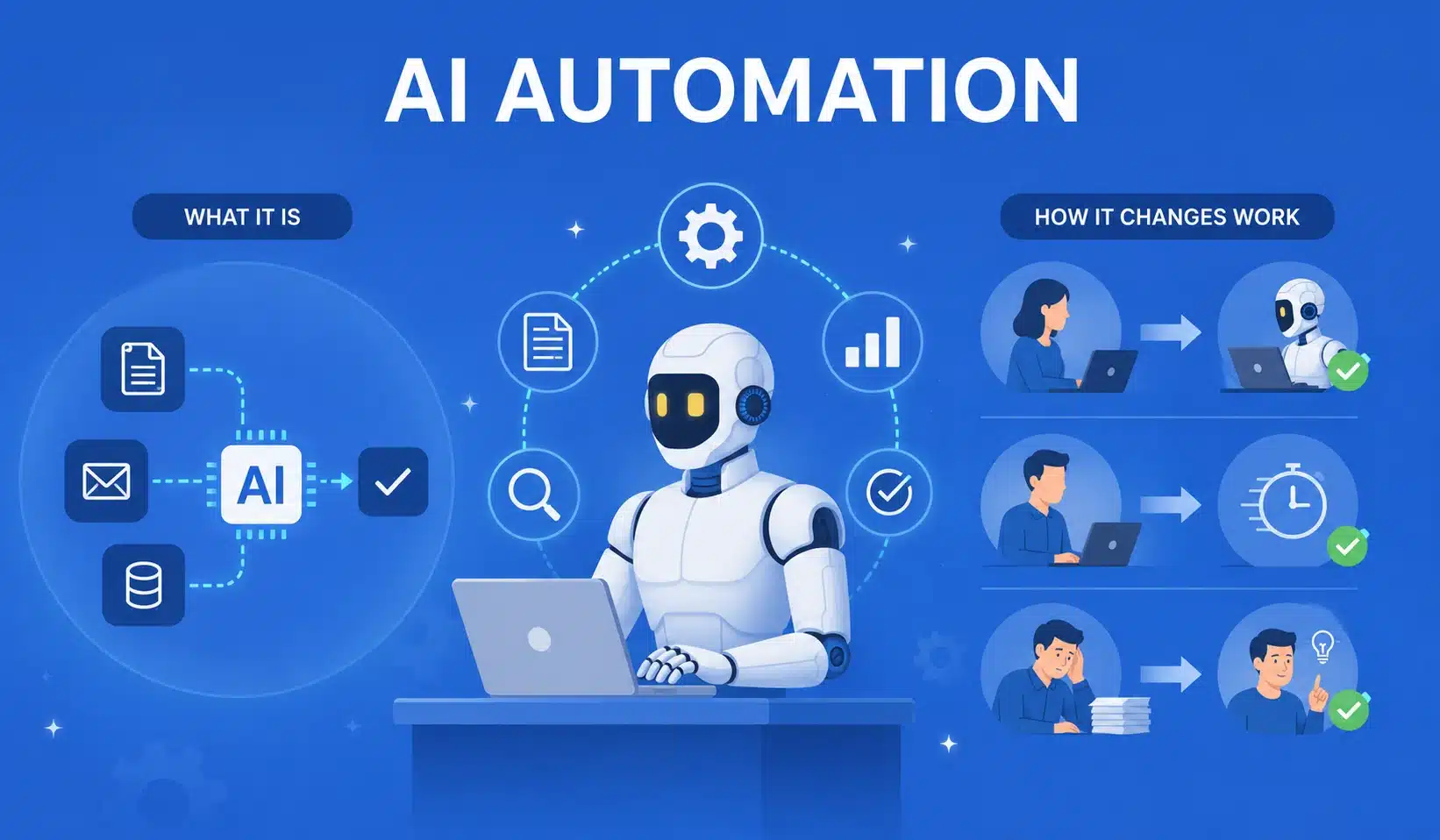
You’ve already used AI automation today. That spam filter in email that caught the phishing email before you even saw it? The chatbot that actually understood your refund request without making you repeat yourself three times?. The fraud alert that pinged your phone two seconds after a suspicious transaction? This all are AI automation.
Most people picture AI automation as something happening inside the data centres of Amazon or Goldman Sachs, far away, abstract, relevant only to tech teams with six-figure software budgets. But that gap between “what AI automation actually is” and “what people think it is” is closing fast. And understanding it properly, not just at a surface level, genuinely matters right now.
So let’s break it down clearly. What is AI automation, what makes it different from regular automation, and what does it actually mean for the way we work?
Isn’t All Automation Just… Automation?
Traditional automation, which engineers have been building since the 1990s, runs on fixed rules. If a form is submitted, send a confirmation email. If a file lands in this folder, move it there.
Robotic process automation (RPA), the workhorse of enterprise IT for the last two decades, works exactly this way: software robots mimic human clicks and keystrokes, executing the same sequence of steps thousands of times a day, without ever deviating. Reliable. Precise. And completely incapable of handling anything it wasn’t explicitly programmed for.
The moment something unexpected happens, a field name changes, a document arrives in a slightly different format, traditional RPA breaks. It needs a human to fix it.
AI automation is a different animal entirely. Instead of following a script, it learns. It reads unstructured data emails, PDFs, voice recordings, images, and figures out what to do with them. Spot patterns in data that no human analyst would catch manually.
And makes decisions, adapts when inputs change, and gets better over time through machine learning. That’s the core distinction: traditional automation does tasks. AI automation thinks about tasks.
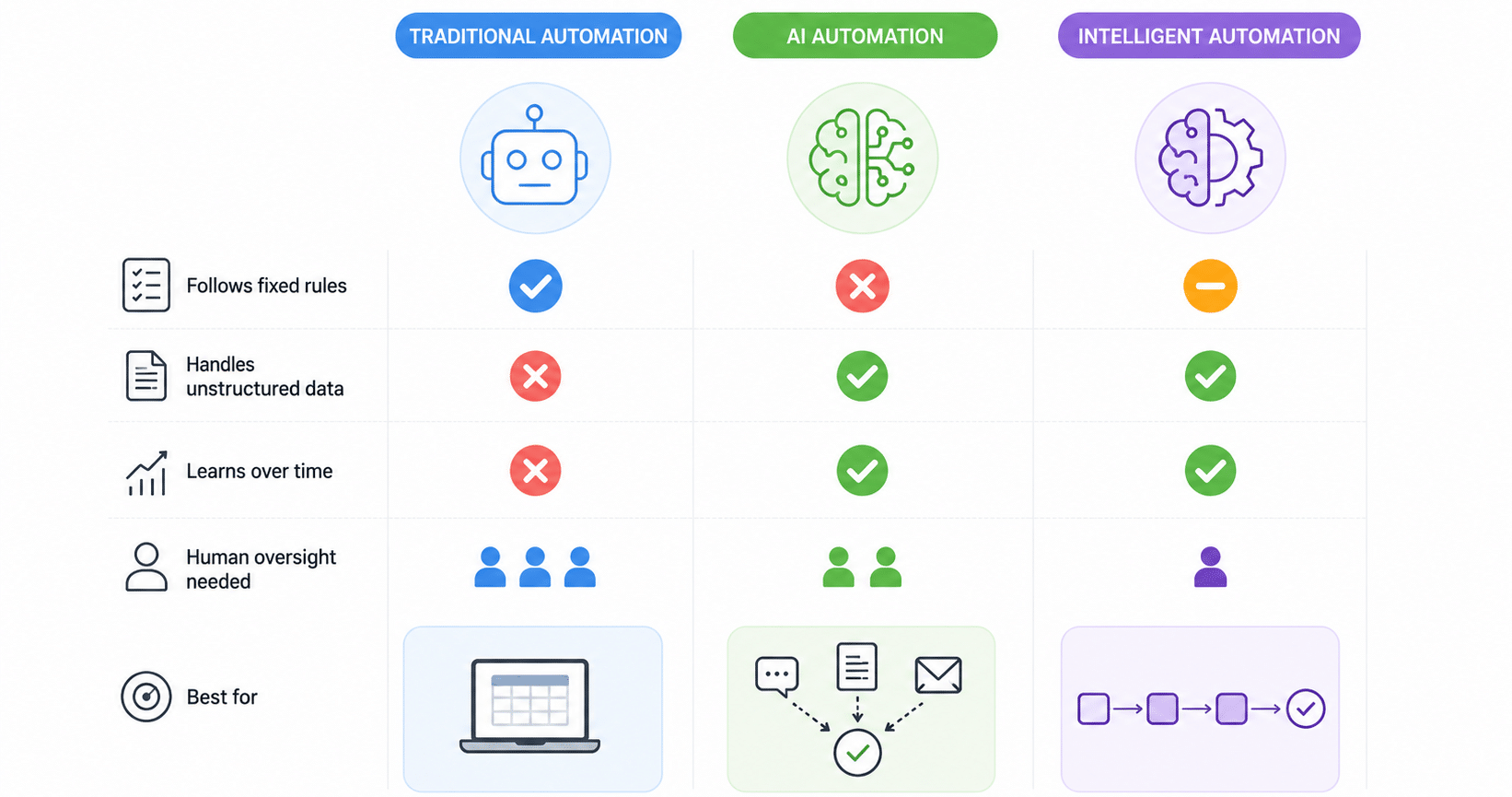
Here’s a quick way to see the difference:
| Feature | Traditional Automation (RPA) | AI Automation | Intelligent Automation |
| Follows fixed rules | Yes | No | Partial |
| Handles unstructured data | No | Yes | Yes |
| Learns over time | No | Yes | Yes |
| Human oversight needed | High | Medium | Low–Medium |
| Best for | Repetitive data tasks | Complex decisions | End-to-end workflows |
Intelligent automation, the combination of AI with traditional automation, sits in the middle. It takes RPA’s reliability and pairs it with machine learning, natural language processing, and cognitive automation capabilities. The result is a system that can handle complexity that would’ve stopped a classic bot cold.
It’s Not One Thing, It’s Three Layers Built on Top of Each Other
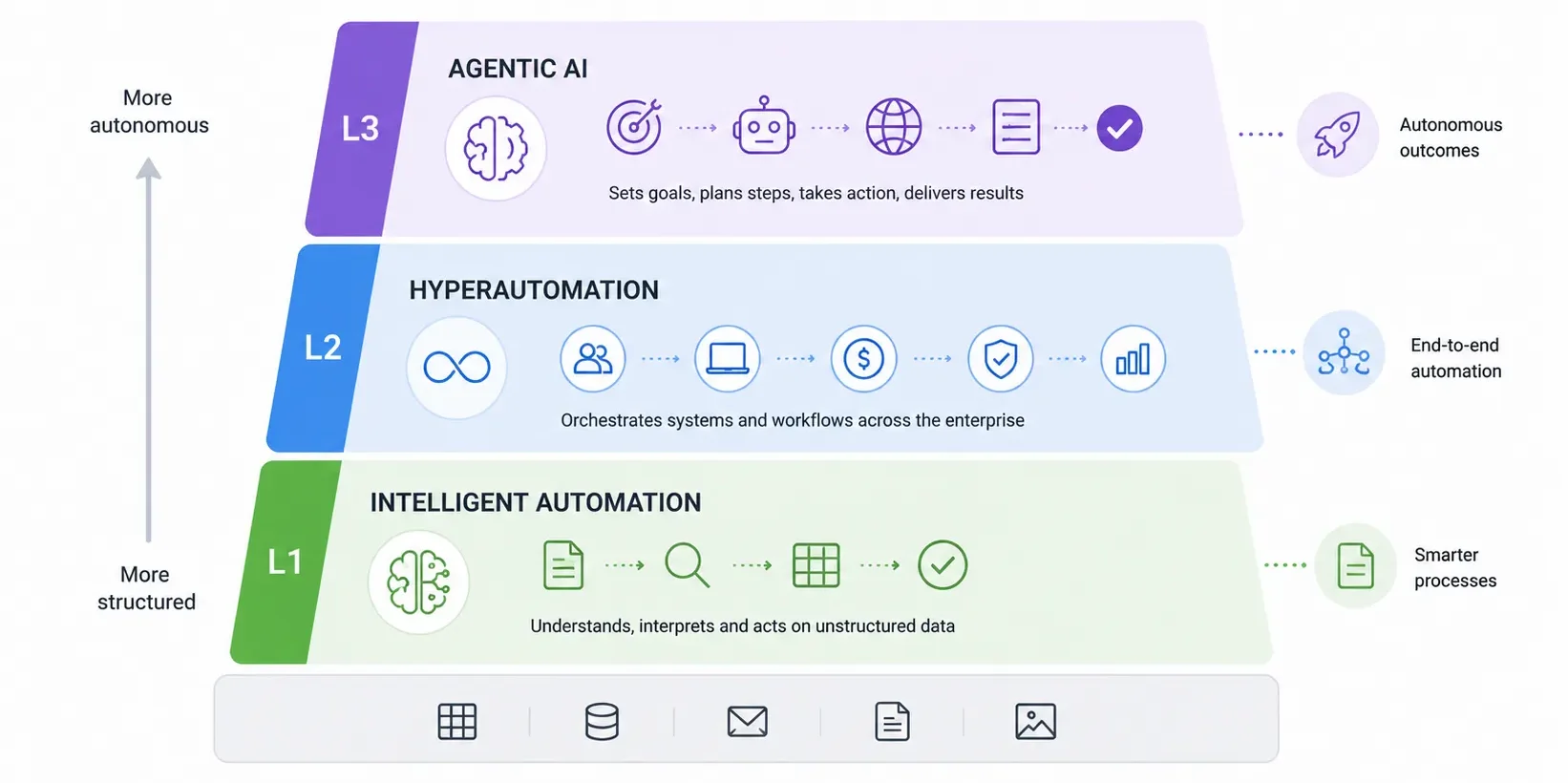
Think of AI automation less like a single technology and more like a stack, each layer more capable than the one beneath it. Most businesses are somewhere in the middle of this stack right now, either by design or just by accident, of which tools they’ve adopted.
Layer 1: Intelligent Automation
This is where most enterprises actually live. Intelligent automation combines RPA with machine learning, natural language processing, and cognitive automation, giving software the ability to read, interpret, and act on information that isn’t neatly structured in a spreadsheet.
Think about invoice processing. A traditional RPA bot can extract data from an invoice, but only if every invoice looks identical. An intelligent automation system reads invoices from 200 different suppliers, each formatted differently, and still extracts the right numbers with 97%+ accuracy. It handles the messy reality of business data instead of demanding that reality conform to its rules. That’s cognitive automation doing the heavy lifting.
Layer 2: Hyperautomation
Gartner coined this term, and for once, the analyst-speak is actually useful. Hyperautomation isn’t just automating one task or one department; it’s automating the automation itself across an entire organisation. Finance, HR, procurement, compliance, and IT support are all connected, all talking to each other, with AI orchestrating the handoffs between systems.
A practical example: when a new employee joins a company running hyperautomation, the HR system triggers the IT system to provision a laptop, the finance system to set up payroll, the facilities system to assign a desk, and the legal system to send NDAs, all without a single human coordinating any of it. Machine learning automation improves each of these flows over time based on what went wrong before.
McKinsey’s State of AI survey found that 88% of organisations now regularly use AI in at least one business function. But only about a third have started scaling it across the enterprise. That gap between using AI somewhere and running hyperautomation everywhere is exactly where most companies are stuck right now.
Layer 3: Agentic AI
This is the genuinely new layer. And honestly, it changes the game in a way the previous two layers didn’t.
Agentic AI doesn’t just execute instructions. Give it a goal, “research our top five competitors and summarise their pricing strategies” and it figures out the steps itself. It searches the web, reads documents, synthesises information, checks its own output, and delivers a finished brief. No step-by-step programming. No human is guiding each action. Just an objective and an AI agent that pursues it autonomously.
The numbers reflect how fast this is moving. Agentic AI now accounts for 50% of AI-related job function changes, up from just 29% in 2023, according to IMF data. AI workflow automation is evolving from “automating a task” to “running an entire workflow with minimal human input.” Tools like Claude, ChatGPT with tools enabled, and specialised agents built on platforms like LangChain are already doing this in production environments, not just in demos.
Here’s what makes agentic AI genuinely different from everything that came before it: previous automation required humans to define every possible scenario in advance. Agentic AI handles scenarios that haven’t been anticipated. A legal research agent that finds relevant case law, drafts a preliminary memo, and flags what needs senior review, completing in 20 minutes what used to take eight hours, isn’t following a script. It’s reasoning.
That shift from execution to reasoning is the most significant thing happening in AI and automation right now. Everything else is incremental. This isn’t.
So, Where Is AI Automation Actually Being Used Right Now?
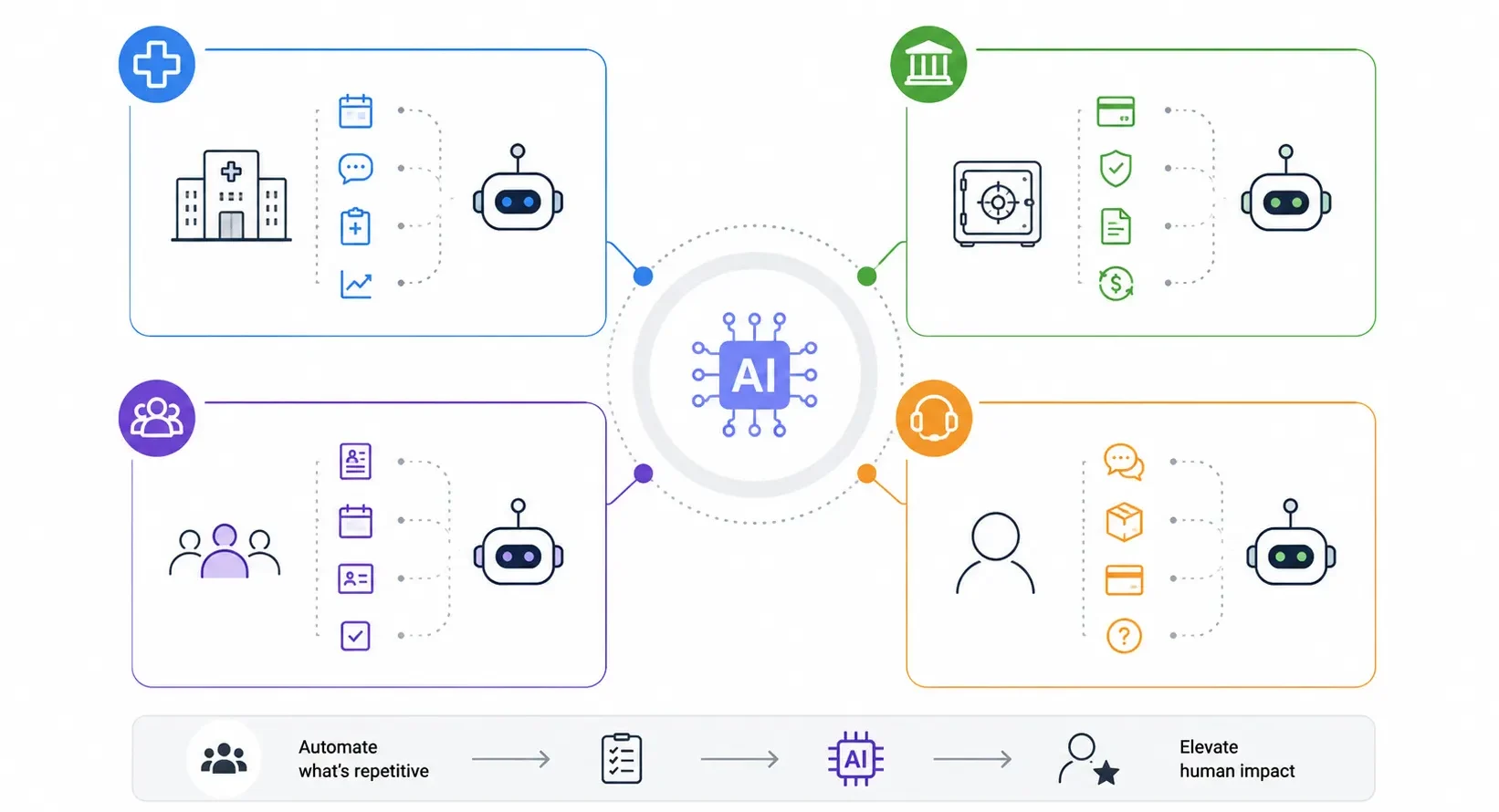
Everywhere is the honest answer. But let’s get specific because “AI is transforming every industry” is the kind of sentence that sounds meaningful and says nothing. Here’s what AI automation examples look like in practice, across the sectors where the impact is most visible right now.
Healthcare
AI automation in healthcare has moved well beyond the hype. Administrative tasks that used to consume 30–40% of a clinician’s day, appointment scheduling, patient communication, insurance pre-authorisation, and clinical documentation, are now largely handled by automated systems. At major hospital networks in the US and UK, AI tools scan incoming patient data, flag anomalies in test results, and route urgent cases to the right specialist faster than any human triage process could.
The numbers are striking. A Stanford HAI report found that AI-assisted healthcare processes improved operational efficiency by up to 37x in some diagnostic applications. That’s not a typo. The bottleneck was never the doctors it was the paperwork surrounding them.
Finance and Banking
AI automation in finance is where the technology has been running longest and at the largest scale. Fraud detection systems at banks like HSBC and JPMorgan process millions of transactions per second, flagging suspicious patterns in real time, something no team of human analysts could physically do. Loan application screening, compliance reporting, trade reconciliation, and AML (anti-money laundering) checks all of it runs on business process automation AI now, with humans reviewing exceptions rather than processing every case.
The productivity math is brutal in the best way. Goldman Sachs has publicly stated that AI tools have reduced the time spent on certain legal document review processes by over 70%. That’s not efficiency at the margin; that’s restructuring how entire functions operate.
HR and Recruitment
AI automation in HR tends to get a bad reputation, understandably, given early chatbot disasters and algorithmic bias scandals. But the reality of what’s actually being deployed is more nuanced and, frankly, more impressive.
Resume screening, interview scheduling, onboarding workflow management, benefits administration, and employee query handling all of this is now routinely handled by intelligent automation. An HR team of five can genuinely manage processes that previously required twenty people, because the AI handles the high-volume, rule-based cognitive work while the humans focus on the decisions that actually require judgment, like whether a candidate’s unusual career path is a red flag or a hidden asset.
Customer Service
This is probably where most people encounter AI task automation without ever registering it as such. AI chatbots and voice agents now handle somewhere between 60 and 80% of routine customer service queries across major consumer brands, including returns, order tracking, account changes, and basic troubleshooting. Intercom’s Fin AI, for example, resolves complex support queries that previously required live agents, maintaining brand voice and handling exceptions without a script.
Indian e-commerce platform Dukaan replaced 27 customer service agents with a ChatGPT-powered system, cutting costs by 99% while maintaining 85% customer satisfaction. That’s an extreme case, and not every company should go that far. But it illustrates what AI automation in customer service can do when implemented decisively.
You know what ties all of this together? In every one of these industries, business process automation AI isn’t replacing entire departments overnight. It’s eliminating the repetitive cognitive work, the tasks that were never a good use of human intelligence in the first place, so that people can focus on the work that actually requires them.
That distinction matters. A lot. Which brings us to the question everyone’s actually thinking about.
The Job Question. Let’s Actually Answer It.
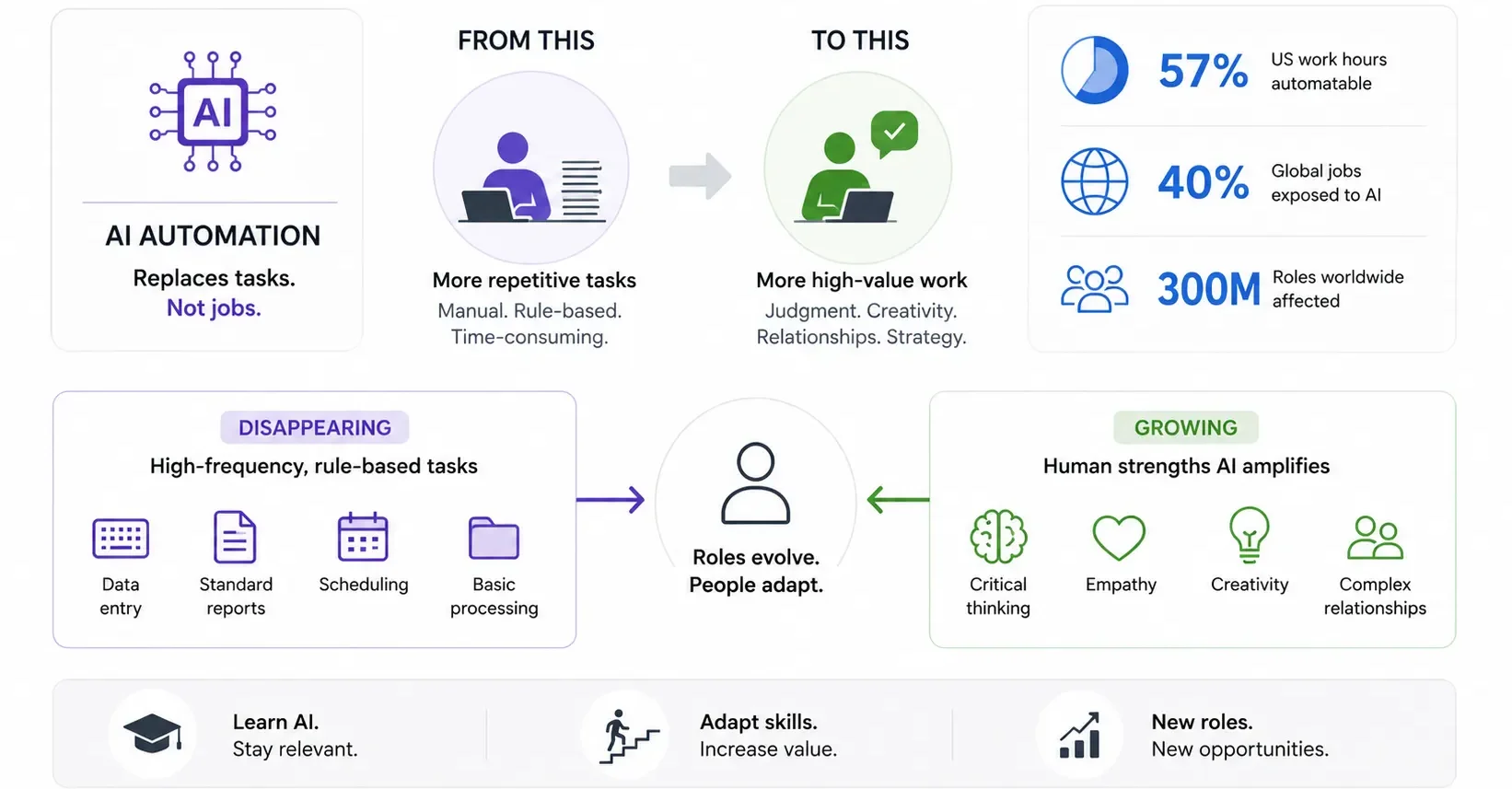
Nobody reads an article about AI automation without wondering, at least quietly, whether their job is on the list. So let’s not bury this in corporate-speak about “workforce transformation” and “reskilling opportunities.” Here’s what the data actually says.
McKinsey’s research arm estimates that today’s AI, not some future version, that exists right now, could theoretically automate approximately 57% of current US work hours. The IMF puts roughly 40% of global jobs as meaningfully exposed to AI capabilities. Goldman Sachs models suggest around 300 million full-time roles worldwide could be affected by generative AI over the coming decade.
Those numbers are real. And they’re worth sitting with for a moment.
But here’s what they actually mean because “affected” and “eliminated” are very different things, and most headlines treat them as synonyms.
AI automation replaces tasks. Not jobs.
This is the distinction that almost every alarmist gets wrong about AI job automation. Technology rarely eliminates entire occupations in one move. What it does, what it has always done, from the industrial revolution through the computing era, is eliminate specific tasks within jobs, forcing the role itself to evolve.
A customer service manager who once supervised ten agents now oversees an AI system handling routine queries while personally managing complex escalations and relationship-sensitive cases. An accountant who spent 60% of their time on data entry now spends that time on financial planning, strategic analysis, and client advisory. The job title hasn’t changed. The actual work has shifted dramatically toward the parts that required human intelligence all along.
The workers most at risk aren’t those whose jobs sound automatable. Similar concerns have sparked ongoing debates about whether AI technologies will reshape or replace certain professional roles. They’re the ones who refuse to adapt to AI tools.
That’s a meaningful distinction. Research consistently shows that professionals who learn to use AI tools in their existing roles become significantly more productive and more valuable, not redundant.
What’s actually disappearing and what isn’t
High-frequency, rule-based cognitive tasks face the earliest disruption: data entry, basic report generation, routine financial processing, appointment scheduling, and standard legal document review. These are the tasks that were never a great use of human cognitive capacity anyway; they just happened to be what the job required before AI could do them better.
Roles centred on genuine judgment, creative problem-solving, empathy, and complex human relationships are proving far more resistant. Not immune but resistant. A therapist, a strategic consultant, a skilled negotiator, a product designer working at the intersection of technology and human need, AI automation makes their support functions faster, but it doesn’t replace what they actually do.
The creation side of the equation
Here’s the part that gets less coverage dramatically: AI and future of work research consistently shows job creation happening alongside displacement, not instead of it. The World Economic Forum projects that 92 million roles will be displaced by 2030 but 170 million new roles will be created in the same period.
Prompt engineers, AI governance officers, human-AI collaboration specialists, AI workflow architects. These are real jobs that barely existed three years ago and are now actively advertised on LinkedIn.
Every major wave of automation in history has followed this pattern. The future of work AI is building looks less like mass unemployment and more like mass reclassification, a chaotic, uneven, genuinely difficult transition for many workers, but not the end of human work.
That said, and this matters, the transition won’t be painless or equitable. The workers who bear the highest disruption cost are often those with the least capacity to absorb it: lower-wage workers in administrative and clerical roles, in markets without strong retraining infrastructure. How AI is changing work at the top of the skills distribution looks very different from how it’s changing work at the bottom. Acknowledging that honesty is part of understanding what AI automation actually is.
The net story on AI automation’s impact on employment is transformation, not subtraction. But transformation is still hard, and pretending otherwise doesn’t help anyone prepare for it.
The Upside Is Real. So Are the Pitfalls.
Let’s be clear about something: the productivity gains from AI automation for business aren’t theoretical anymore. They’re showing up in quarterly results, in headcount decisions, and in how fast certain companies are pulling away from competitors who haven’t moved yet.
McKinsey data shows AI-augmented teams achieving productivity improvements of up to 40% on knowledge work tasks. That’s not a pilot programme result, that’s what happens when AI automation tools are properly integrated into actual workflows, not just installed and ignored. Companies running intelligent automation across finance, HR, and operations are processing work in hours that used to take days. Scaling without hiring proportionally. Catching errors before they compound. Making decisions based on real-time data rather than last month’s report.
For smaller operations, the AI automation benefits are arguably even more pronounced. A solo consultant using Claude or ChatGPT with the right workflow can research, draft, analyse, and communicate at a pace that would’ve required a three-person team five years ago. A small e-commerce business running automated inventory management, customer query handling, and personalised email sequences competes in ways that were simply out of reach before. AI automation in the workplace isn’t just a large-enterprise story anymore; that ship has sailed.
The scalability point is worth dwelling on for a second. Traditional business growth required proportional headcount growth. More customers meant more support staff, more administrators, more coordinators. AI automation breaks that relationship. The workload can double; the team doesn’t have to. That’s a genuinely new economic dynamic, and it’s one of the core reasons adoption is accelerating so fast.
But, and this is important, the risks are just as real.
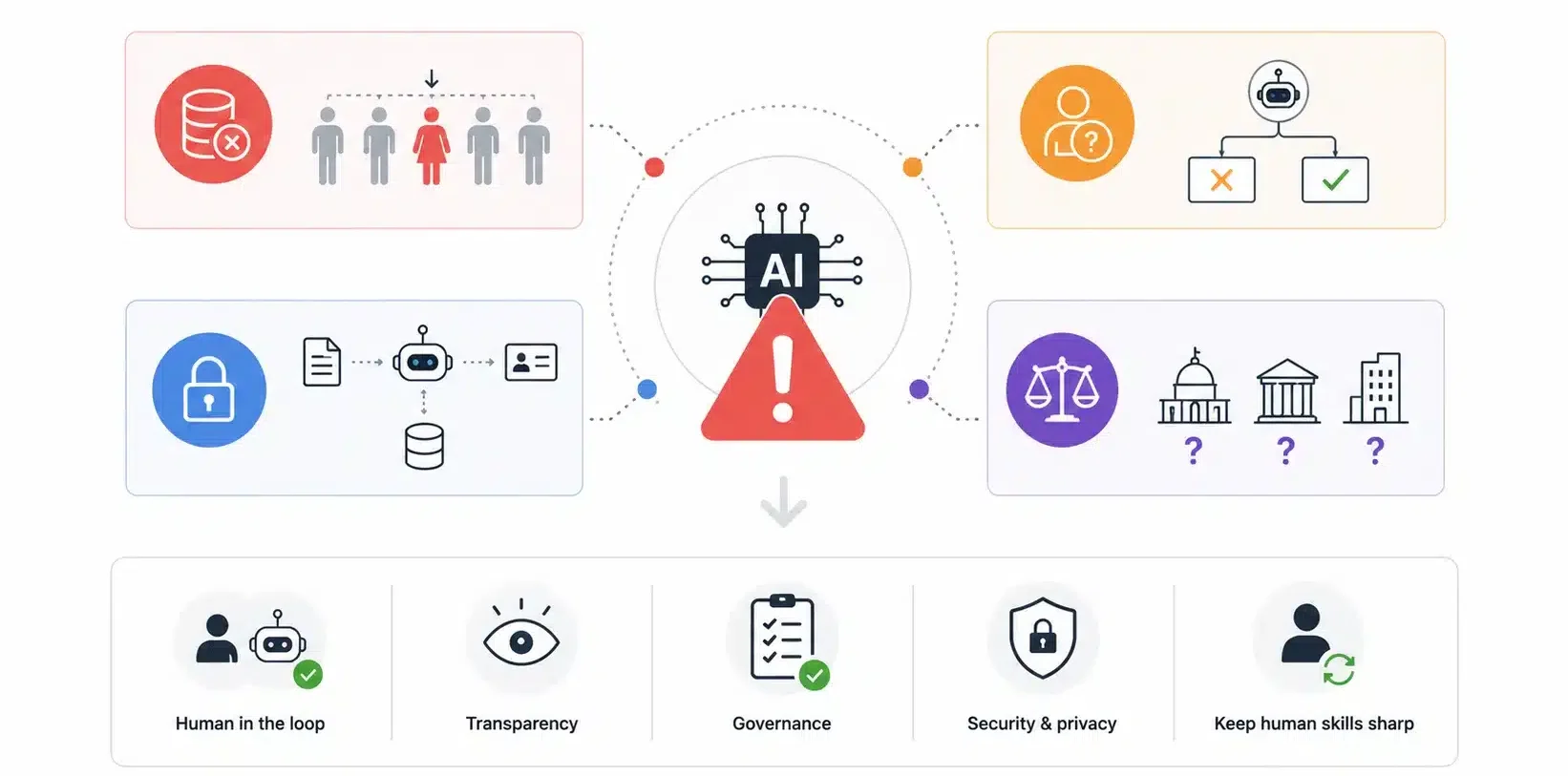
Poor implementation doesn’t just fail quietly. It spreads bad decisions faster than humans ever could. An AI system trained on biased data doesn’t make one biased decision; it makes millions of them, at scale, before anyone notices. Amazon’s now-infamous AI recruiting tool, which systematically downgraded resumes from women because it had been trained on a decade of male-dominated hiring data, is the cautionary tale every AI automation team should have memorised.
Over-automation creates its own category of problem. When AI systems handle decisions that previously required human judgment without adequate oversight mechanisms, accountability becomes murky. Who’s responsible when an automated underwriting system denies a loan it shouldn’t have? The vendor? The bank? The model? These aren’t hypothetical questions. Regulators in the EU, UK, and increasingly the US are asking them right now, and the answers are still being worked out.
Data privacy and security concerns intensify as AI automation processes more sensitive information. Every new workflow you automate is a new potential attack surface. AI systems that touch payroll data, medical records, or customer financial information need governance frameworks that most organisations haven’t built yet, not because they’re irresponsible, but because the technology moved faster than the policy.
The honest framing on AI automation risks is this: the technology is powerful enough that getting it wrong has proportionally large consequences. That doesn’t mean moving slowly; companies that move too slowly will fall behind in ways that are hard to recover from. It means moving deliberately. Knowing which decisions can be safely automated and which ones need a human in the loop isn’t a philosophical question; it’s the core operational challenge of running AI automation responsibly in 2026.
There’s also a subtler risk that rarely makes the headlines: over-reliance eroding capability. When teams stop doing tasks because AI handles them, the institutional knowledge embedded in those tasks can quietly disappear. A finance team that hasn’t manually reconciled accounts in two years may struggle to catch the edge case that the AI mishandles because they’ve lost the muscle memory for the work. Automation should augment human capability, not quietly hollow it out.
The Tools Actually Worth Your Attention
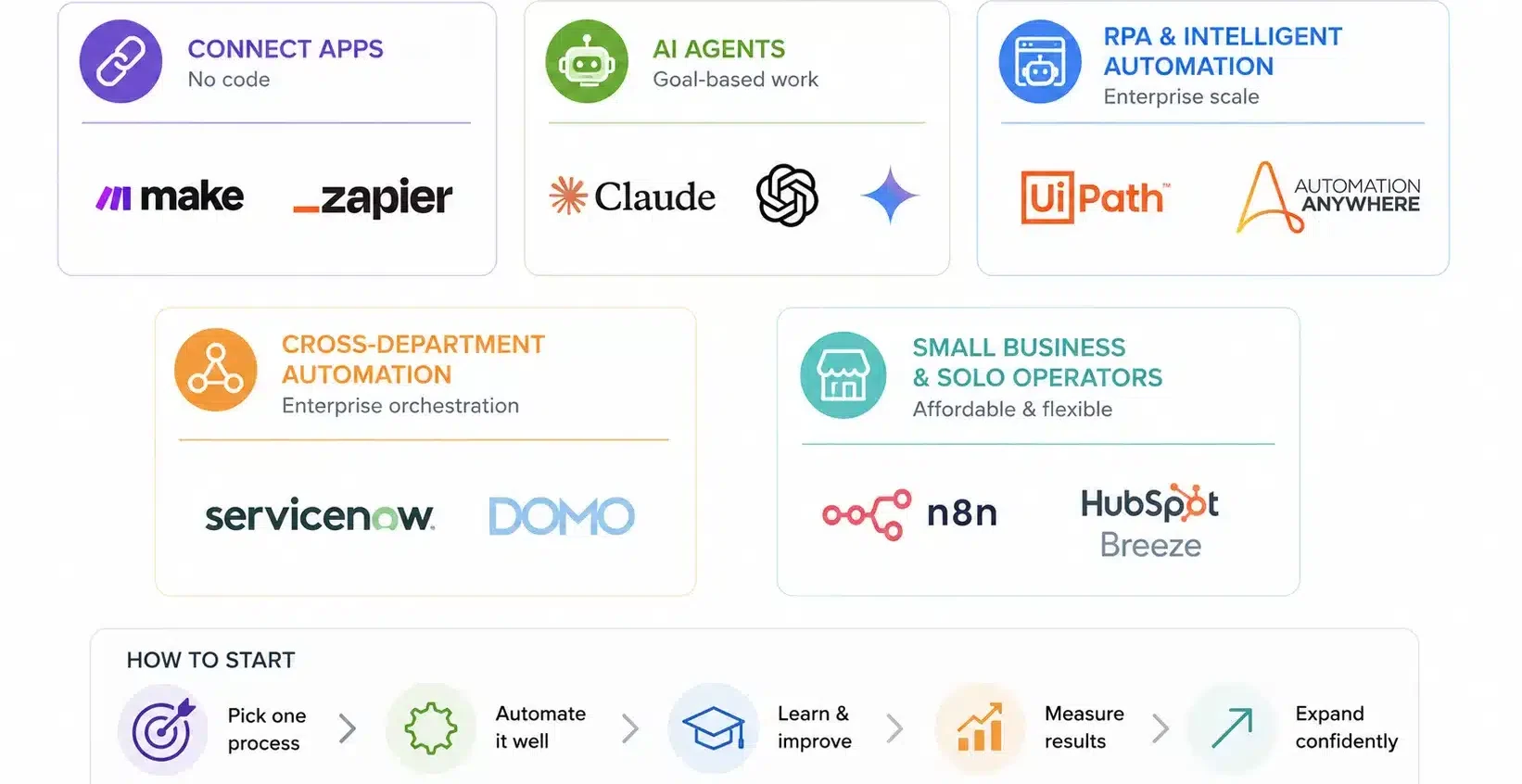
There’s no shortage of platforms claiming to be the answer to all your automation needs. Most of them are fine. A few are genuinely excellent. Here’s a practical breakdown, not a sponsored list, just an honest map of the landscape.
For connecting apps without writing code
Make.com and Zapier are the entry points most teams reach for first, and for good reason. They handle AI workflow automation across hundreds of app integrations, moving data between CRMs, email platforms, project management tools, and spreadsheets without requiring engineering resources. If you’re a small business and you haven’t explored these yet, that’s the first thing to fix.
For AI agents at work
Claude (Anthropic), ChatGPT with tools enabled, and Gemini Advanced are the current frontrunners for goal-based agentic work. These aren’t just chatbots anymore. With the right setup, they research, draft, analyse data, and execute multi-step tasks with minimal hand-holding. The gap between what these tools could do 18 months ago and what they do now is significant.
For enterprise-scale RPA and intelligent automation
UiPath and Automation Anywhere are the dominant platforms, both now heavily AI-augmented. They’re built for large organisations running complex, high-volume workflows across legacy systems that don’t have modern APIs. Not cheap. But for the right use case, transformatively effective.
For business process automation AI across departments
ServiceNow and Domo handle cross-system orchestration at the enterprise level, connecting IT, HR, finance, and operations workflows into a coherent automated layer. These are the platforms behind the hyperautomation deployments at major corporations.
For small businesses and solo operators
n8n (free, self-hosted, surprisingly powerful) and HubSpot Breeze are worth serious attention. AI automation tools for small businesses don’t have to mean enterprise pricing. n8n in particular gives you genuinely sophisticated AI task automation without a subscription fee.
The right tool isn’t the most powerful one or the most popular one. It’s the one that fits the specific workflow you’re actually trying to automate. Start narrow. Pick one process, automate it well, learn from it, then expand.
Conclusion
AI automation isn’t coming. It’s here, running inside the tools you already use, the services you already interact with, the companies you already buy from. Understanding what it actually is, how the layers of intelligent automation build on each other toward genuinely agentic AI, and what it honestly means for jobs and work that’s not optional knowledge anymore.
The future of work AI is building looks fundamentally different from what came before. Not because humans stop working, but because the nature of valuable human work shifts away from execution, toward judgment; away from processing, toward meaning-making; away from following instructions, toward knowing which instructions to give.
That shift creates real disruption for real people. It also creates real opportunity for businesses that move thoughtfully, for workers who adapt deliberately, and for anyone who takes the time to actually understand what they’re dealing with.
FAQs
Traditional automation follows predefined rules and workflows, while AI can learn from data, adapt to new situations, and make decisions based on context. Automation focuses on executing repetitive tasks, whereas AI enables systems to handle complex and unstructured processes.
A common example is AI-powered invoice processing. The system can read invoices from different suppliers, extract key information automatically, validate the data, and enter it into accounting software without manual input.
Roles that rely heavily on creativity, emotional intelligence, leadership, negotiation, strategic thinking, healthcare, education, and complex human relationships are generally less susceptible to full automation.
Small businesses can use AI automation for customer support, lead qualification, appointment scheduling, email marketing, social media management, invoicing, data entry, and workflow automation without requiring a large technology budget.
Hyperautomation is the combination of AI, machine learning, RPA, and workflow orchestration tools to automate end-to-end business processes across multiple departments and systems.
Agentic AI is an advanced form of AI automation that can independently plan, reason, and execute multi-step tasks to achieve a goal. Unlike traditional automation, it does not require every step to be predefined by humans.