

Artificial intelligence (AI) has rapidly evolved from a niche area of computer science into one of the most influential technologies of the modern era. From helping doctors detect diseases earlier to enabling businesses to automate repetitive work, AI has become an essential part of everyday life. As governments, organizations, and researchers continue investing in intelligent systems, the conversation has shifted from whether AI will transform society to how artificial intelligence is changing the world and what lies ahead.
The increase in AI is bringing a new way to businesses everywhere. But at the same time, new AI applications are generating questions on privacy, security, work, and society. The ability to harness the power of artificial intelligence, while understanding how AI impacts people’s lives and jobs, allows companies and people alike to take their first step in becoming AI-ready for the future.
The Evolution of AI
The journey of AI began with simple theories about machine intelligence and has grown into advanced systems capable of learning, reasoning, and generating human-like content. Early AI focused on solving mathematical problems and playing strategy games, but improvements in computing power, cloud technology, and machine learning have accelerated its development.
Today’s AI systems can analyze numerous datasets, recognize speech and images, generate content, write code, and assist in scientific research. Modern generative AI platforms are smart enough to demonstrate how fast technology can evolve when supported by powerful neural networks and large amounts of data.
The future of AI is expected to feature more AI systems that will amplify human productivity while automating routine activities rather than replacing them.
How AI Will Impact the Future
Artificial intelligence is expected to influence nearly every aspect of society. While some changes are already visible, others will reshape industries over the coming decade.
| Area | Current Impact | Future Outlook |
|---|---|---|
| Business | Automation improves efficiency | AI-driven decision-making becomes standard |
| Employment | Routine jobs are changing | New AI-focused careers continue to emerge |
| Privacy | Greater data collection | Stronger privacy regulations and secure AI |
| Regulation | Governments drafting policies | Global AI governance frameworks |
| Environment | High computing energy demand | More energy-efficient AI infrastructure |
Improved Business Automation
Current Impact
Businesses use AI to automate repetitive processes, analyze customer behavior, improve inventory management, and enhance productivity. Customer support chatbots, predictive analytics, and intelligent workflow automation are helping companies decrease costs while improving efficiency.
Future Outlook
Automation will extend beyond repetitive work to support strategic decision-making. AI assistants will collaborate with employees, helping organizations make faster and data-driven decisions while allowing human workers to focus more on creativity and innovation.
Job Disruption
Current Impact
AI has already changed roles in manufacturing, customer support, finance, and software development. Some repetitive positions are becoming less dependent on human intervention, while demand for AI specialists continues to rise.
Future Outlook
Although certain jobs may disappear, AI will also create entirely new professions involving AI ethics, prompt engineering, robotics, cybersecurity, and intelligent system management. Upskilling and continuous learning will become increasingly important.
Data Privacy Issues
Current Impact
AI systems rely on large amounts of data to improve accuracy. This has increased concerns about personal information, user tracking, and responsible data collection practices.
Future Outlook
Organizations will adopt privacy-first AI models that use stronger encryption, improved consent management, and transparent data handling. Governments are also expected to introduce stricter regulations protecting consumer information.
Increased Regulation
Current Impact
Countries around the world are introducing AI policies covering transparency, accountability, copyright, and responsible development. Businesses must now consider compliance alongside innovation.
Future Outlook
International cooperation may lead to standardized AI regulations that promote innovation while decreasing misuse. Companies that prioritize responsible AI development are likely to earn more public trust.
Climate Change Concerns
Current Impact
Training advanced AI models requires significant computing resources, increasing electricity consumption and carbon emissions. Large data centers have become an important environmental consideration.
Future Outlook
Technology companies are investing in energy-efficient processors, renewable-powered data centers, and optimized AI models that decrease environmental impact while maintaining excellent performance.
What Industries Will AI Impact the Most?
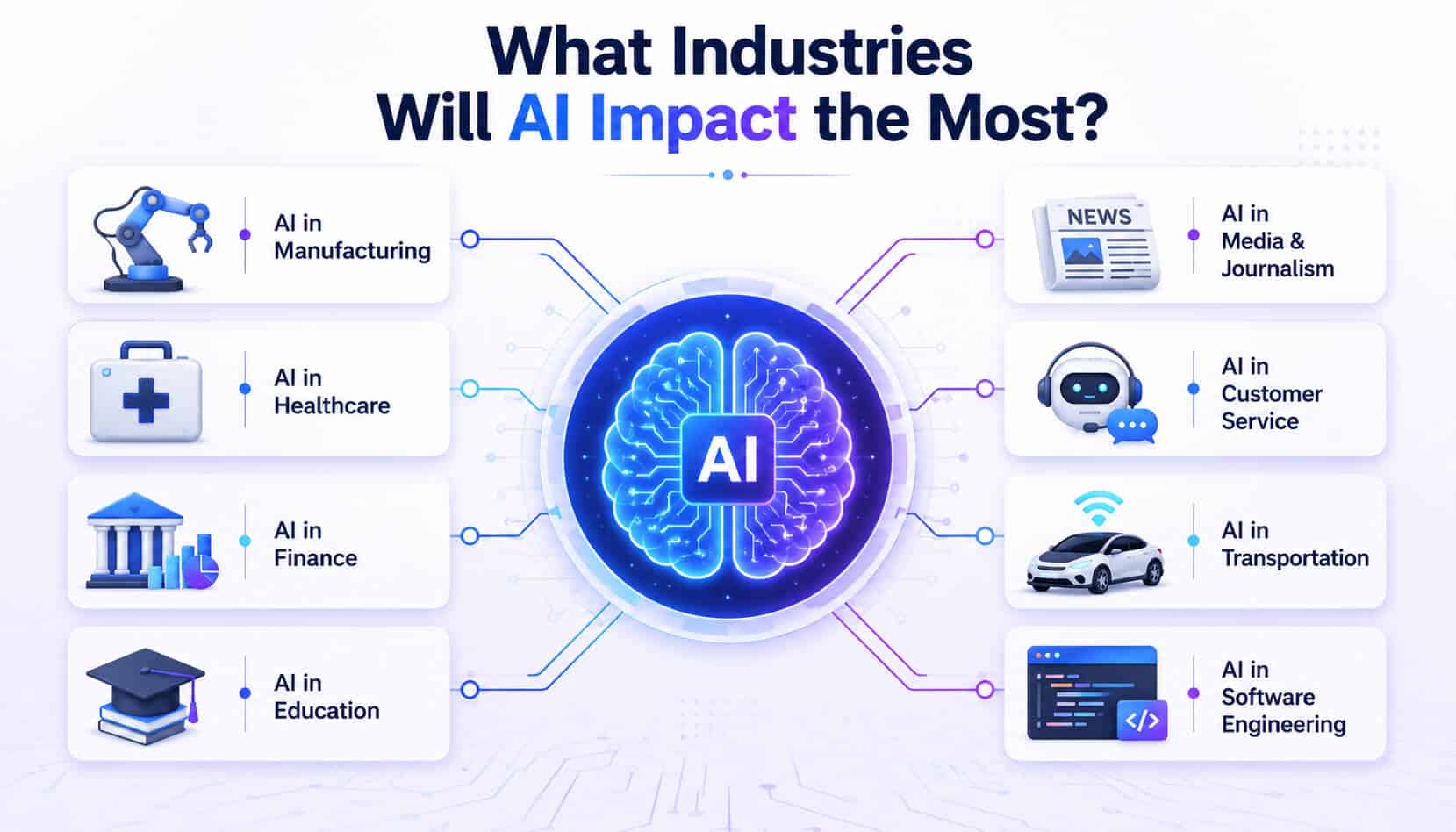
AI is transforming nearly every sector by improving efficiency, reducing operational costs, and enabling excellent decision-making.
AI in Manufacturing
Manufacturers use AI for predictive maintenance, quality inspection, inventory optimization, and robotics. Smart factories decrease downtime while improving production efficiency.
AI in Healthcare
Healthcare providers leverage AI for medical imaging, disease diagnosis, drug discovery, patient monitoring, and personalized treatment planning. These innovations help doctors to make faster and more accurate decisions.
AI in Finance
Banks and financial institutions rely on AI to detect fraud, assess credit risk, automate customer support, and improve investment strategies. AI also improves digital payment security and financial forecasting.
AI in Education
Educational institutions use AI-powered learning platforms to personalize lessons, automate assessments, and offer students real-time learning support. Intelligent tutoring systems can help learners progress at their own pace.
AI in Media and Journalism
AI assists journalists by analyzing large datasets, generating news summaries, translating content, and supporting research. Media organizations also use AI to recommend personalized content to readers.
AI in Customer Service
Customer service has become faster and more efficient with AI-powered chatbots, virtual assistants, and automated ticketing systems. These tools handle common customer queries around the clock, allowing human agents to focus on more complex issues. As conversational AI continues to improve, businesses can provide fast responses while maintaining a personalized customer experience.
AI in Transportation
The transportation industry is using AI to optimize traffic management, improve route planning, and enhance vehicle safety. Ride-sharing platforms rely on AI for demand forecasting, while logistics companies use intelligent algorithms to streamline deliveries. Autonomous driving technology is also advancing, although widespread adoption will depend on continued testing and regulatory approvals.
AI in Software Engineering
Software developers increasingly use AI to generate code, identify bugs, automate testing, and improve documentation. AI coding assistants accelerate development without replacing the need for skilled engineers. As development tools evolve, programmers will spend more time solving complex problems while AI handles repetitive coding tasks.
Key Benefits of Artificial Intelligence
The growing adoption of AI delivers several advantages across industries, including:
- Improves productivity by automating repetitive work.
- Improves decision-making through data analysis.
- Decreases operational costs for businesses.
- Supports personalized customer experiences.
- Accelerates scientific research and medical discoveries.
- Strengthens fraud detection and cybersecurity.
- Enables smarter cities and transportation systems.
- Helps organizations make faster, evidence-based decisions.
These advantages explain how AI will change the world by making technology more accessible, efficient, and intelligent across both personal and professional environments.
Risks and Dangers of AI
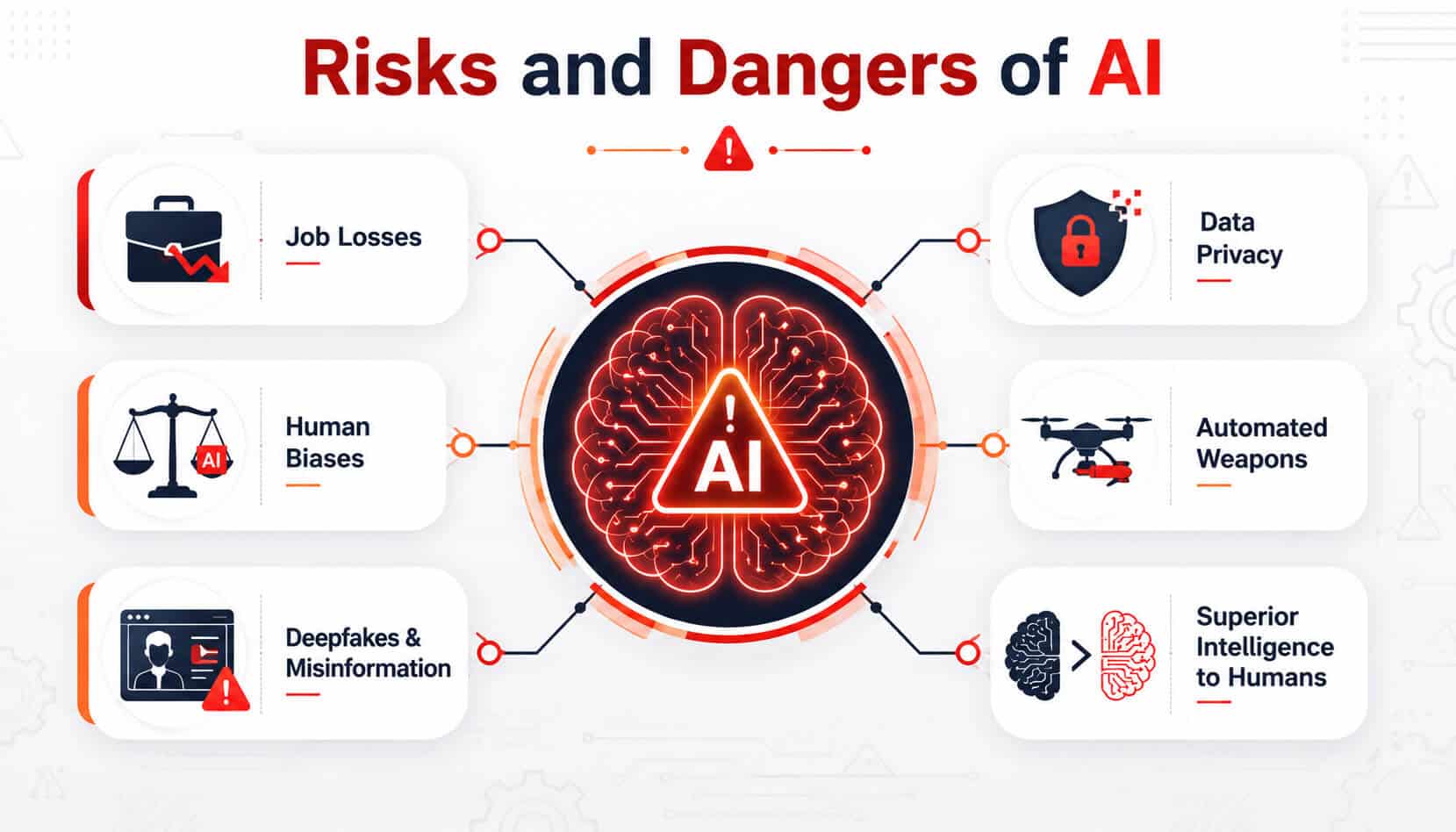
While AI offers remarkable opportunities, understanding the risks and benefits of artificial intelligence is essential for responsible adoption.
Job Losses
Automation may decrease the demand for certain repetitive and routine jobs. Industries like manufacturing, retail, and customer support are already experiencing workforce changes. However, new career opportunities are emerging in AI development, cybersecurity, data science, and AI governance.
Human Biases
AI systems learn from current data. If that data contains bias, AI models may unintentionally produce unfair or discriminatory results. Organizations must continuously audit and improve AI systems to ensure fairness and transparency.
Deepfakes and Misinformation
Generative AI can create highly realistic AI images, videos, and audio. While this technology has legitimate uses, it also increases the spread of misinformation, identity fraud, and manipulated media. Detecting AI-generated content is becoming an important priority for governments and technology companies.
Data Privacy
Many AI applications process large amounts of personal information. Without proper safeguards, sensitive data could be exposed or misused. Strong cybersecurity practices, transparent privacy policies, and responsible data governance are essential for building public trust.
Automated Weapons
AI-powered military technologies raise ethical and security concerns. Autonomous weapons capable of making targeting decisions without direct human intervention have sparked international debates about regulation and accountability.
Superior Intelligence to Humans
Some experts believe future AI systems could surpass human capabilities in specific areas. Although such scenarios remain theoretical, researchers emphasize the importance of developing AI responsibly, ensuring humans retain oversight and control over advanced systems.
Notable AI Milestones
The history of AI includes several breakthroughs that have shaped today’s intelligent technologies.
GPT-5 Release (August 2025)
To demonstrate how modern AI can excellently understand complex instructions and assist across professional, educational, and creative work, GPT-5 introduced significant improvements in reasoning, multimodal capabilities, coding assistance, and accuracy.
First Global AI Safety Summit Held (November 2023)
World leaders, researchers, and technology companies gathered to discuss responsible AI development, safety standards, and international cooperation. The summit highlighted the growing importance of balancing innovation with ethical governance.
ChatGPT Debuts (November 2022)
The public launch of ChatGPT transformed how millions of people interact with AI. It introduced conversational AI to mainstream users and accelerated global investment in generative artificial intelligence.
Transformer Architecture Introduced (June 2017)
The introduction of the Transformer architecture revolutionized natural language processing. It became the foundation for today’s most advanced large language models and generative AI systems.
Deep Blue Defeats Chess Champion Garry Kasparov (May 1997)
IBM’s Deep Blue defeated world chess champion Garry Kasparov, demonstrating that computers could outperform humans in highly strategic work under specific conditions.
First Trainable Neural Network Demonstrated (1957)
Frank Rosenblatt’s perceptron marked one of the earliest practical demonstrations of machine learning, laying the groundwork for modern neural networks and deep learning.
Conclusion
Understanding how artificial intelligence is changing the world requires looking beyond automation alone. AI is transforming various industries such as healthcare, finance, education, transportation, manufacturing, customer service, and software engineering while creating new opportunities for innovation and economic growth. At the same time, challenges like privacy, misinformation, bias, and workforce disruption require thoughtful regulation and responsible development.
The future of artificial intelligence will depend on how governments, researchers, businesses, and society work with AI to maximize its advantages while minimizing its risks. Organizations that embrace ethical AI practices and individuals who continue learning new skills will be excellently prepared for a future where intelligent technology becomes an integral part of daily life.
Frequently Asked Questions
1. How is artificial intelligence changing the world?
AI is improving productivity, automating repetitive work, enhancing healthcare, supporting education, strengthening cybersecurity, and enabling smarter business decisions across multiple industries.
2. What are the benefits of artificial intelligence?
The advantages of artificial intelligence include improved efficiency, excellent data analysis, decreased operational costs, personalized customer experiences, medical advancements, and faster innovation.
3. How can AI change the world in the future?
AI is expected to transform transportation, healthcare, manufacturing, education, scientific research, and business automation while creating new career opportunities and improving decision-making.
4. What are the biggest risks of AI?
Major risks include job displacement, data privacy concerns, algorithmic bias, deepfakes, cybersecurity threats, and the misuse of autonomous technologies.
5. Which industries will AI impact the most?
Manufacturing, healthcare, finance, education, media, customer service, transportation, and software engineering are expected to experience some of the greatest AI-driven transformation.
6. Will AI replace humans?
AI is more likely to automate specific tasks rather than replace people entirely. Human creativity, critical thinking, emotional intelligence, and ethical judgment will continue to play an essential role.