

Messaging apps have become part of everyday life, but not all of them protect your conversations in the same way. Many platforms advertise encryption, yet the level of security varies significantly. Some encrypt every message automatically, while others require users to manually enable a separate mode that many people never discover.
If you’re searching for the best secure messaging app or trying to compare the safest encrypted messaging app available today, it’s important to look beyond marketing claims. A truly encrypted messaging app should protect your conversations by default, not only when users change settings.
This guide compares today’s leading messaging platforms based on one simple question: Does the app provide end-to-end encryption by default, or does it only offer encryption as an optional feature? We’ll also examine how each app handles metadata, privacy policies, anonymity, and overall security so you can choose the right solution for your personal or professional needs.
What Does End-to-End Encryption Really Protect?
End-to-end encryption (E2EE) means that only the sender and the intended recipient can read the contents of a message. Neither the app provider, internet service provider, hackers, nor anyone intercepting the communication can decrypt the message while it is being transmitted.
This level of protection forms the foundation of every best end to end encrypted messaging app, secure communication app, and private messaging app.
However, encryption doesn’t automatically protect everything.
Most messaging platforms still collect metadata, including:
- Who you communicate with
- When conversations take place
- How frequently you exchange messages
- Device information
- IP addresses
- Approximate location
This information isn’t the message itself, but it can still reveal a surprising amount about your habits.
For example, both Signal and WhatsApp use the Signal Protocol to encrypt messages. While message content receives similar protection, Signal is specifically designed to collect as little metadata as possible. WhatsApp, owned by Meta, gathers considerably more account and usage information for operational and business purposes.
Understanding this distinction is essential when choosing a secure messaging platform rather than relying solely on the phrase “end-to-end encrypted.”
What is an Encrypted Message?
Encrypted messaging is a secure way to communicate online. Using special software, in messaging apps with an end-to-end signal encryption, messages are converted into code that can only be read by the sender and receiver. This makes it difficult for anyone else to intercept and read the messages, even if they are able to access the data. In addition to being used by individuals, encrypted messaging is also often used by businesses and organizations to protect sensitive information. Needless to say, encrypted messaging provides an extra layer of security that can be vital in protecting your privacy.
How Can You Select the Best Safest Messaging App?
In a world where data breaches and cyber attacks are becoming increasingly common, it’s important to make sure that your communications are secure. That’s why many people are turning to message apps with end-to-end encryption. But with so many different apps on the market, how can you choose the best one for your needs?
- Consider what kind of features are important to you.
- Consider which platform you’re using. Some apps only work on one type of phone, while others are available on multiple platforms.
- Think about the price. Some apps are free, while others charge a monthly or yearly subscription fee.
By taking all of these factors into account, you can select the best end-to-end encrypted messaging and calling app for your needs.
Quick Comparison of the Most Secure Messaging Apps (2026)
Whether you need a secure chat app for personal conversations, an encrypted communication app for sensitive discussions, or a secure messaging service for your business, the comparison below highlights the strengths and limitations of today’s leading platforms.
| App | End-to-End Encryption by Default | Best For | Main Trade-Off |
| Signal | Yes | Maximum privacy | Contacts must also use Signal |
| Yes (messages only) | Everyday communication | Extensive metadata collection | |
| iMessage | Yes (Apple devices only) | iPhone users | Falls back to SMS/RCS with Android |
| Threema | Yes | Anonymous messaging | Paid application |
| Telegram | No (Secret Chats only) | Public channels and communities | Regular chats aren’t E2EE |
| Session | Yes | Complete anonymity | Smaller user base |
| Wire | Yes | Business collaboration | Enterprise-focused platform |
| Briar | Yes | Offline communication | Limited adoption |
Most Secure Encrypted Messaging Apps
The below list will have the pros and cons of the apps and a brief about the history of the app with privacy threats.
These are the candidates for the most secure and safest messaging app.
1. Signal: The Gold Standard for Private Messaging
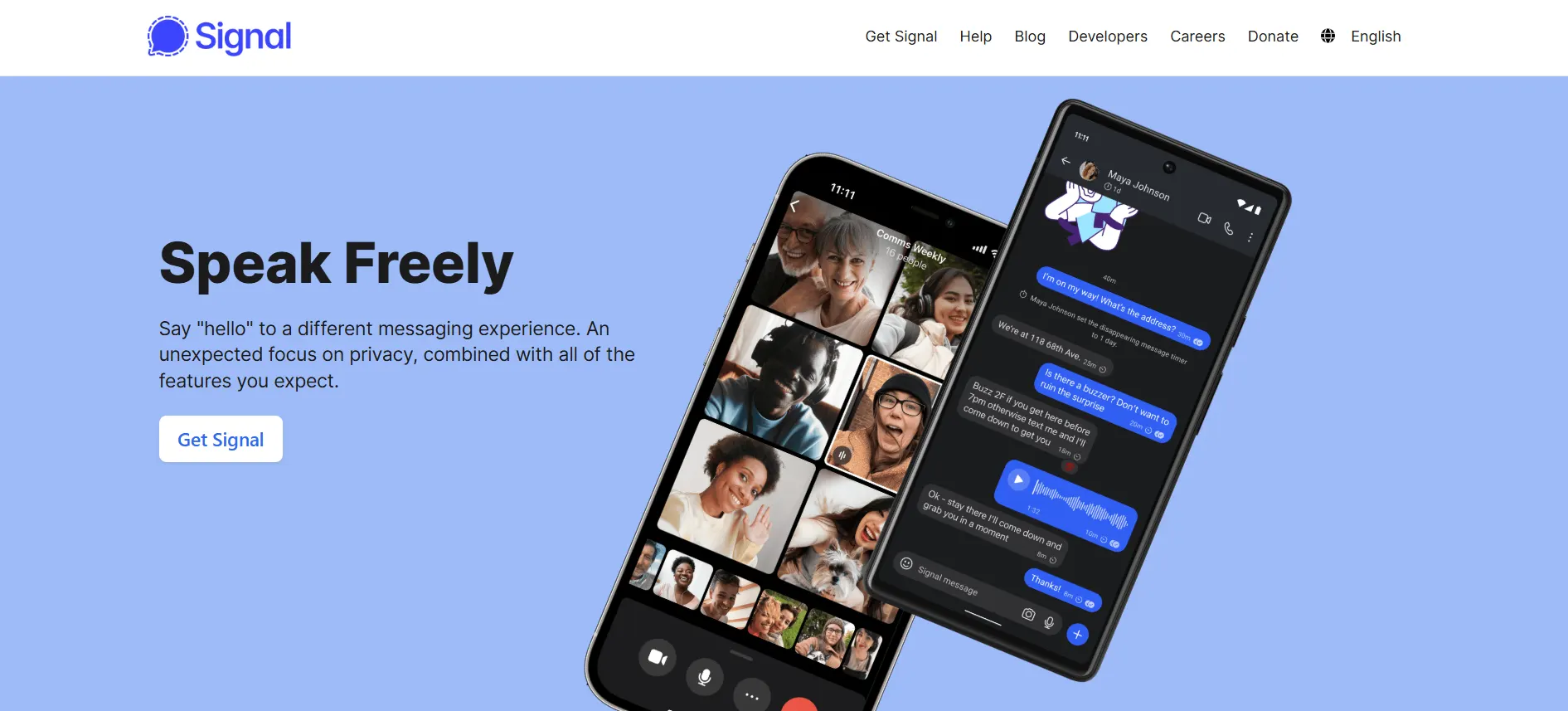
Signal is widely regarded as the best secure messaging app available today. Security experts, journalists, cybersecurity professionals, and privacy advocates consistently recommend it because every message, voice call, video call, attachment, and secure group chat is protected using end-to-end encryption by default.
The application uses the independently audited Signal Protocol, one of the most trusted encryption standards in the industry. Signal also introduces an additional privacy feature called Sealed Sender, which reduces the amount of metadata even Signal’s own servers can access.
Unlike many competitors, Signal is operated by a nonprofit foundation rather than an advertising company. Since its business model doesn’t depend on collecting user data, there is little incentive to track user activity or profile conversations.
Another reason privacy professionals recommend Signal is its transparent development model. Much of its source code is publicly available, allowing independent researchers to review how the application handles security.
Best For
Signal is ideal for anyone looking for the most secure messaging app, including journalists, lawyers, activists, businesses handling confidential information, and everyday users who simply value privacy.
The only notable limitation is adoption. Since conversations require both parties to use Signal, convincing friends or family to switch can sometimes be challenging.
| Pros | Cons |
| The gold standard of encryption | No emoji |
| Open-source | No stickers (a few sets at the moment) |
| No data collection | The message is lost if the encryption keys are changed on the fly |
| Self destruct | Not the biggest user base |
| Calls can go through the server to hide the IP | |
| Can even be set as an SMS client |
2. WhatsApp: Biggest End-to-End Encrypted Messaging App
With more than three billion active users worldwide, WhatsApp remains one of the most popular messaging platforms available today. Every personal message, voice call, and video call is protected using the same Signal Protocol employed by Signal itself. This monster of the apps is owned by Facebook
Because of this, WhatsApp continues to rank among the best encrypted messaging apps for protecting message content. However, privacy extends beyond encryption alone.
Although Meta cannot read your encrypted messages, the company still collects significant metadata, including who you communicate with, how often conversations occur, your device information, IP address, and account activity. This information may be used to improve services, comply with legal requests, or support other platform operations.
As a result, WhatsApp represents an excellent compromise between usability and security rather than absolute privacy. In late 2025, WhatsApp also introduced interoperability with selected third-party messaging services for European users under the Digital Markets Act. According to Meta, these interoperable chats continue to use end-to-end encryption while allowing communication across supported platforms.
Best For
WhatsApp remains an excellent secure messenger for users who want strong message encryption without asking everyone they know to install another application.
| Pros | Cons |
| Encryption of the Signal group | Collection of metadata |
| Huge user base | Owned by Facebook |
| Web interface | Limit of 256 People in a single group |
| Stories | Lack of customization |
3. iMessage: A Strong Choice for Apple Users
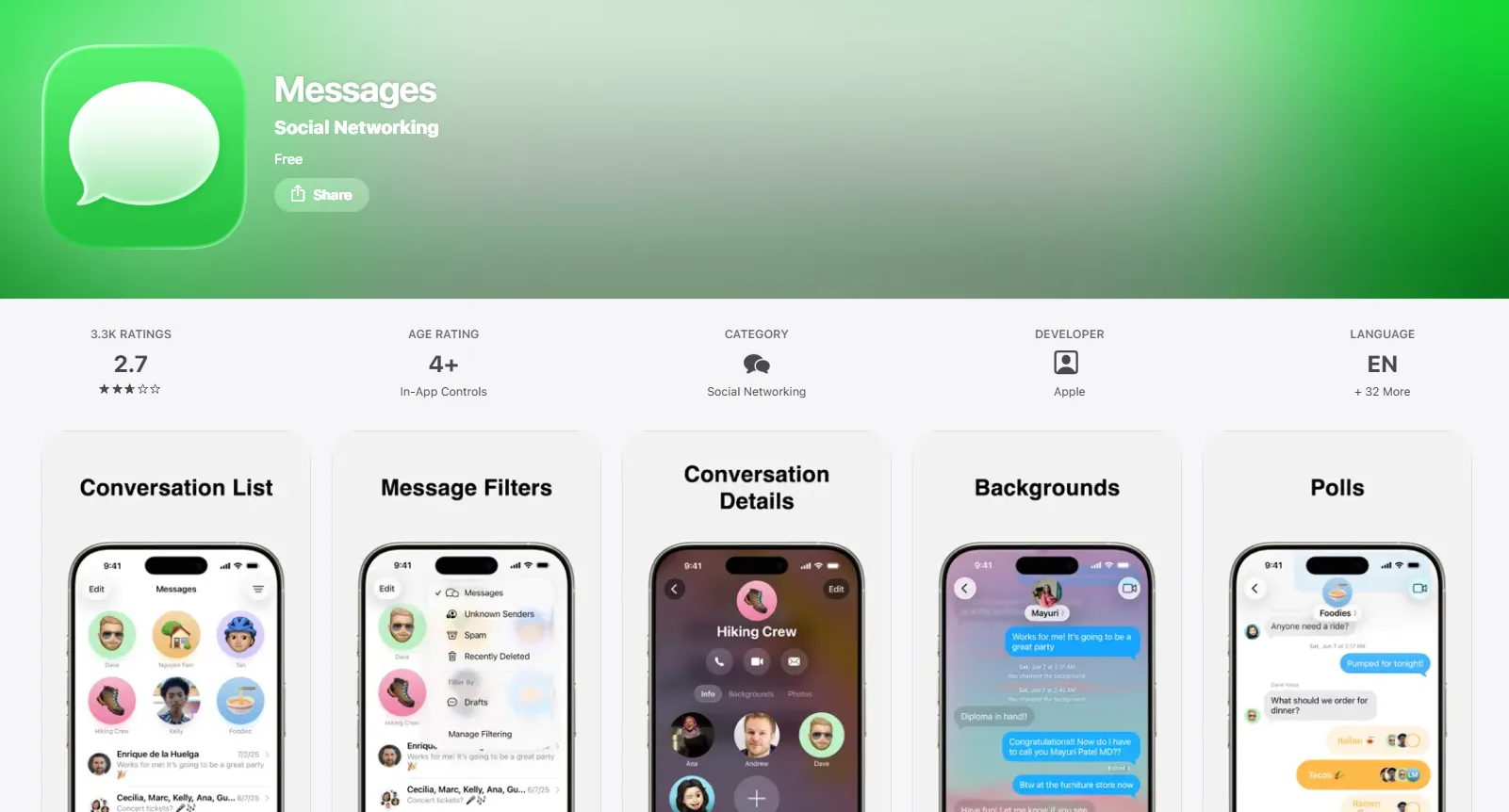
Apple’s iMessage automatically encrypts conversations between Apple devices, making it a reliable, secure messaging app for iPhone users.
Messages exchanged between iPhones, iPads, and Macs are protected using end-to-end encryption by default. Apple has also expanded Advanced Data Protection, allowing encrypted iCloud backups for users who enable the feature.
This significantly improves privacy compared to earlier backup systems.
The limitation appears when conversations include Android users.
Instead of maintaining the same encrypted communication channel, many conversations still rely on SMS or carrier-supported messaging standards that do not always provide equivalent protection.
For people who primarily communicate within Apple’s ecosystem, iMessage delivers a seamless experience while functioning as an effective secure phone messaging app without requiring additional software.
Best For
iMessage is ideal for Apple users whose family members, friends, and colleagues also use Apple devices. It offers strong privacy with virtually no learning curve, making secure messaging effortless for everyday conversations.
| Pros | Cons |
| End-to-end encryption enabled by default for Apple-to-Apple conversations. | Available only within the Apple ecosystem. |
| Seamless integration across iPhone, iPad, Mac, and Apple Watch. | Conversations with Android users may fall back to SMS/RCS, reducing privacy. |
| Supports high-quality media sharing, FaceTime, reactions, and Apple ecosystem features. | No official Android app. |
| Advanced Data Protection can encrypt iCloud backups for additional security. | Less suitable for cross-platform communication. |
4. Threema: Privacy Without Sharing Your Phone Number
If you prefer not to link your messaging account to a phone number or email address, Threema is one of the strongest alternatives available. This Swiss-based application allows users to create an anonymous ID during registration, making it an excellent private messaging app without phone number verification.
Every conversation, file, voice call, and group chat is protected with end-to-end encryption by default. Since Threema stores minimal user data and operates under Switzerland’s privacy regulations, it has earned a strong reputation among individuals and organisations that prioritise confidentiality.
Unlike many free messaging platforms, Threema follows a paid business model. While this requires a one-time purchase, it also means the company isn’t dependent on advertising or extensive data collection to generate revenue.
Businesses looking for secure internal communication also use Threema because of its enterprise offerings and strong privacy controls.
Best For
Threema is an excellent choice for anyone looking for a private messaging app, anonymous encrypted messaging solution, or a secure messaging app without phone number requirements.
| Pros | Cons |
| Uses secure encryption protocols | It’s not an intuitive app, therefore the installation process can be challenging. |
| Its servers do not hold the encryption key or any data transferred between two users | The app can be left without a PIN, leaving the data unprotected. |
| Chatting from a desktop is possible. | The users’ passwords are not encrypted. |
| Instant messaging and server-client encryption make the app useful for businesses. | |
| No contact number is required for texting. |
5. Telegram: Popular but Not End-to-End Encrypted by Default
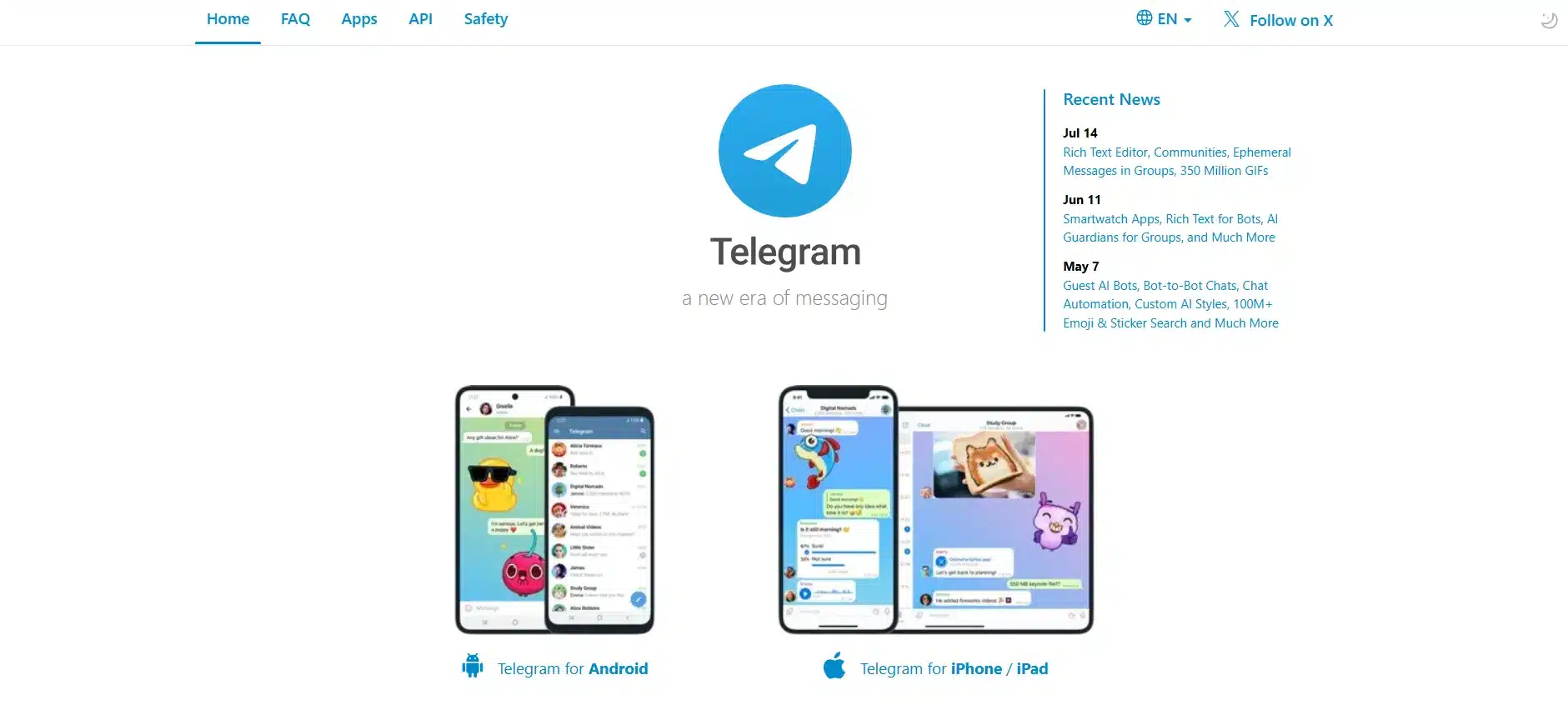
Telegram has built an enormous global community thanks to its fast performance, public channels, bots, and support for very large groups. However, it is often misunderstood from a privacy perspective.
One of the biggest misconceptions is that Telegram encrypts every conversation using end-to-end encryption. In reality, regular chats, group conversations, and channels are not end-to-end encrypted.
Instead, these conversations are encrypted only between your device and Telegram’s cloud servers. This allows Telegram to synchronise messages across multiple devices but also means the company technically has access to message content if legally required.
Telegram’s true end-to-end encryption is available only through Secret Chats, which users must manually enable. Secret Chats are limited to one-to-one conversations and are unavailable for groups or channels.
For users looking for a genuine encrypted chat app or secure instant messaging platform, this distinction is extremely important.
Best For
Telegram remains an outstanding platform for public communities, large discussion groups, educational channels, and business broadcasting.
However, users sharing confidential information should manually activate Secret Chats or consider another end-to-end encrypted messaging app designed with privacy as its primary objective.
| Pros | Cons |
| Massive Channel capacity | No video calling |
| Independent client on both desktop and mobile | Smaller user database than WhatsApp |
| Funded by the founders so no need to share data to make money | Notification on the joining of a contact |
| Large file sharing (1.5 GB max) |
6. Session: Most Secure and Confidential Messaging App
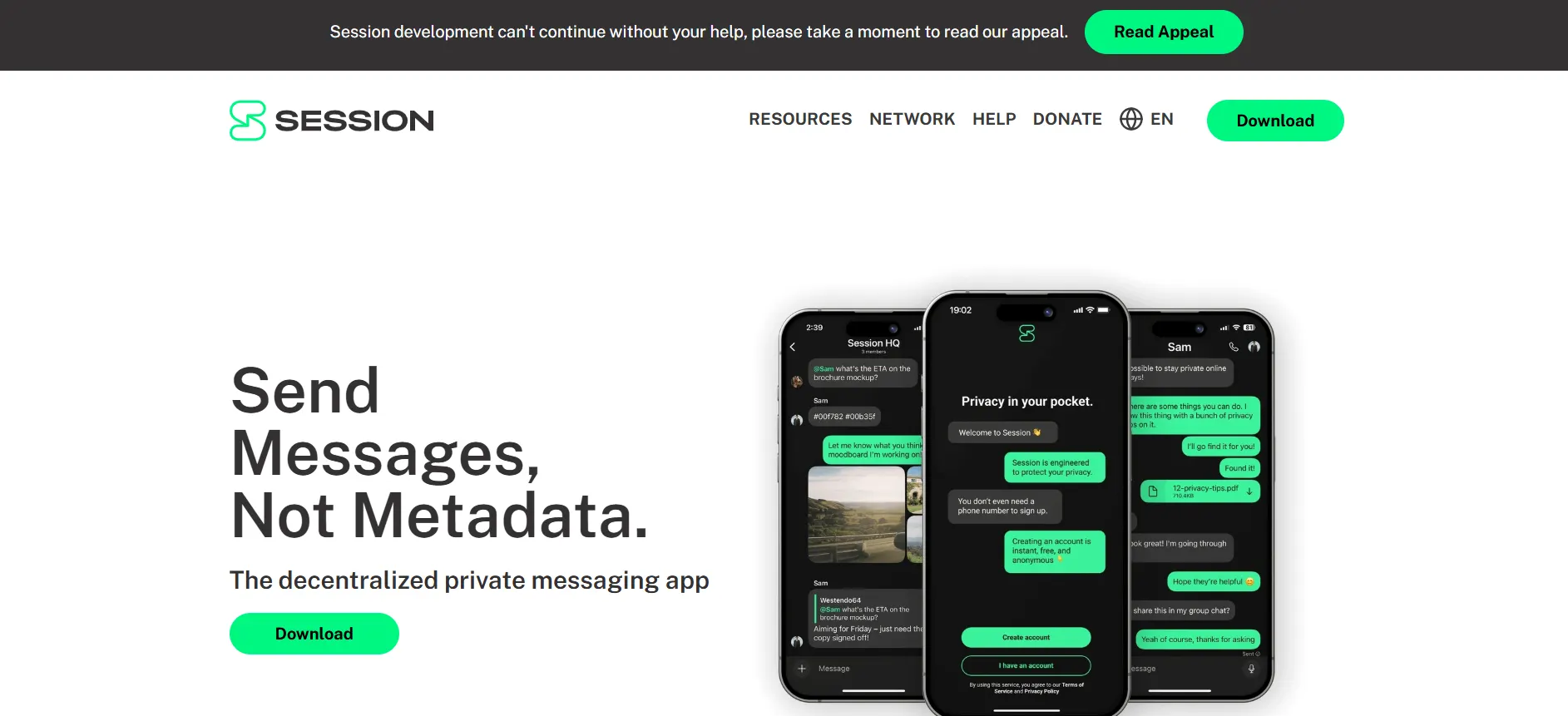
Session takes privacy one step further by removing the need for personal identity altogether. Users don’t need to provide a phone number, email address, or any identifying information when creating an account.
Instead, Session generates a unique Session ID, allowing completely anonymous communication. Messages travel through a decentralised network instead of traditional centralised servers, making it considerably more difficult to trace conversations back to an individual user.
For users prioritising anonymity over convenience, Session stands out as one of today’s leading untraceable messaging app solutions. While its user community is smaller than WhatsApp or Telegram, it delivers exceptional privacy for those who value confidentiality above mainstream adoption.
Best For
Session is ideal for users looking for secure mobile messaging, secure texting, or a highly private communication platform without linking conversations to their real-world identity.
| Pros | Cons |
| No phone number or email required to create an account. | Smaller user community compared to mainstream apps. |
| Designed to minimize metadata collection. | Slower message delivery in some regions due to decentralized routing. |
| Fully decentralized architecture for improved anonymity. | Limited integrations and collaboration features. |
| End-to-end encryption enabled by default. | Fewer advanced communication features than larger messaging platforms. |
7. Wire: Enterprise-Grade Security for Businesses
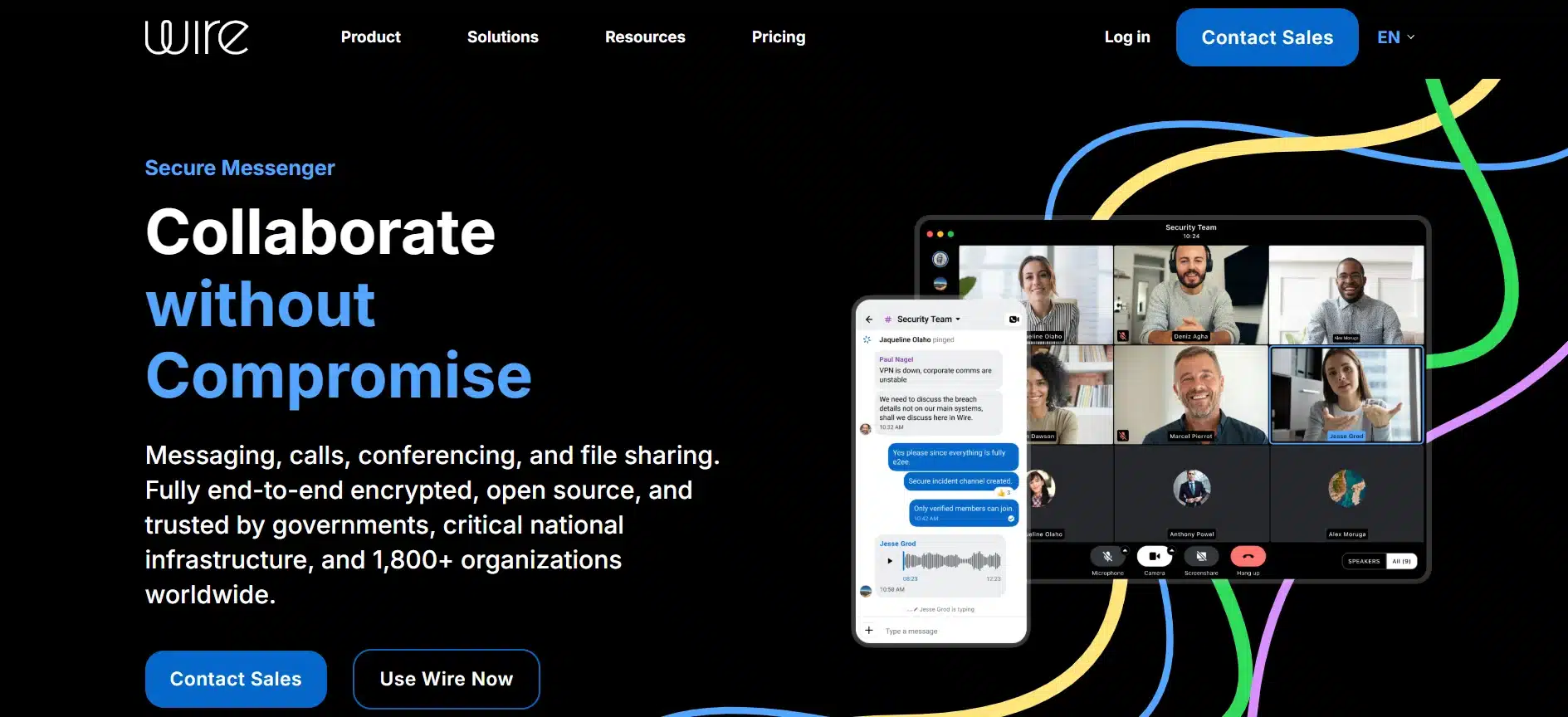
Wire is designed primarily for organisations that require secure collaboration rather than casual social messaging.
The platform combines end-to-end encrypted messaging, encrypted voice and video calls, secure file sharing, and collaboration features into a single workspace. Its architecture supports compliance requirements often needed by enterprises operating in regulated industries.
For organisations handling confidential business information, Wire functions as a professional secure messaging app for business rather than simply another consumer chat application.
Its emphasis on compliance, administration controls, and enterprise security has made it popular among healthcare providers, financial institutions, legal firms, and government organisations.
Best For
Businesses searching for encrypted business chat, secure business messaging, or dependable secure messaging software should consider Wire among their leading options.
| Pros | Cons |
| End-to-end encrypted messaging, voice calls, video meetings, and file sharing. | Many advanced business features require paid plans. |
| Built specifically for business collaboration and enterprise security. | Less popular for personal messaging. |
| Supports compliance requirements for regulated industries. | Smaller user base than WhatsApp or Signal. |
| Available across desktop and mobile platforms. | Some collaboration tools may be unnecessary for casual users. |
8. Briar: Messaging That Works Without the Internet
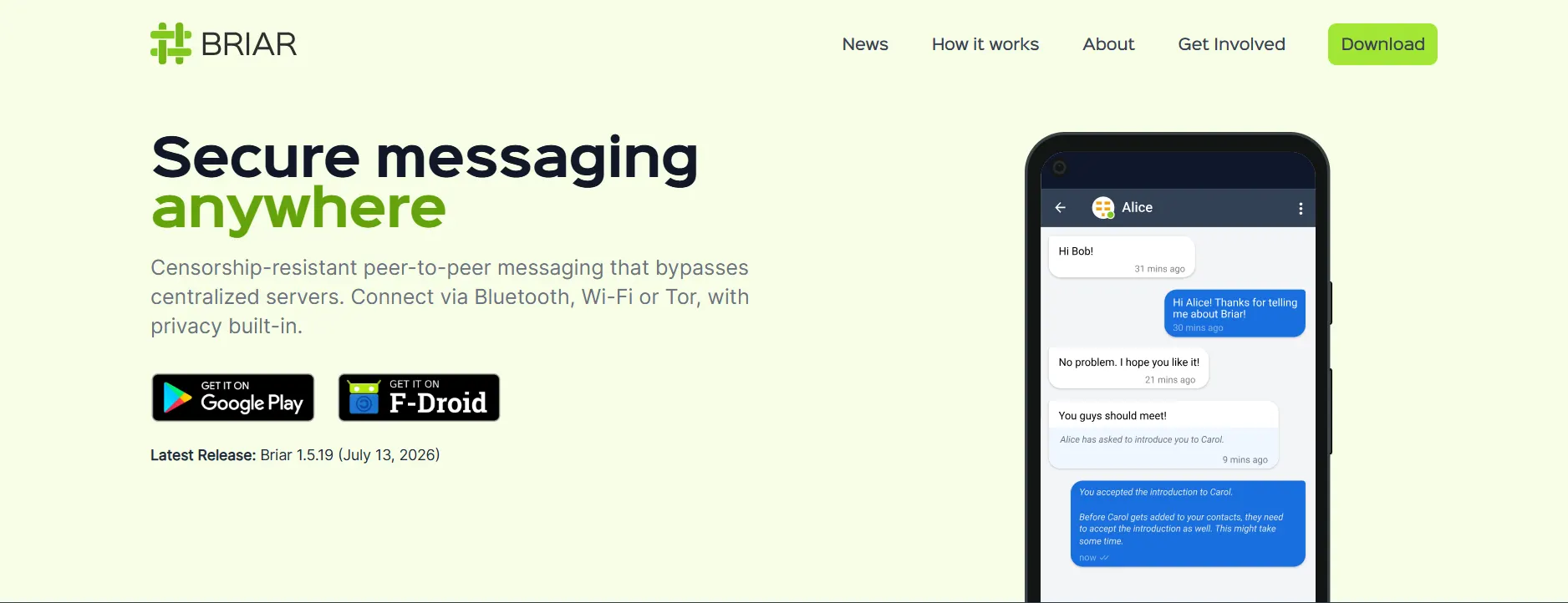
Briar offers something very few messaging applications can provide.
Instead of depending entirely on internet connectivity, Briar can exchange encrypted messages using Bluetooth or Wi-Fi Direct whenever internet access isn’t available.
This capability makes it particularly valuable during internet outages, natural disasters, or government-imposed communication restrictions.
Every conversation remains protected through end-to-end encryption while avoiding central servers entirely.
Although Briar serves a relatively small audience, its architecture has made it a trusted encrypted communication app for journalists, humanitarian workers, and activists operating in high-risk environments.
Best For
Briar is one of the strongest choices for users who require reliable secure communication app capabilities even when traditional internet infrastructure becomes unavailable.
| Pros | Cons |
| Works over Bluetooth and Wi-Fi without internet access. | Android only; no official iOS version. |
| End-to-end encryption by default. | Limited adoption and smaller community. |
| No central servers, improving resistance to censorship. | Fewer modern messaging features. |
| Excellent for activists, journalists, and emergency communication. | Not designed for everyday mainstream communication. |
Should You Trust Snapchat for Private Conversations?
Snapchat is well known for disappearing messages, but disappearing content shouldn’t be confused with strong encryption.
Unlike Signal or Threema, Snapchat does not apply end-to-end encryption consistently across its messaging experience. While certain features receive additional protection, the platform isn’t designed around privacy in the same way as dedicated encrypted messaging services.
If your priority is secure text messaging, encrypted text messaging app functionality, or long-term privacy from the platform itself, Snapchat shouldn’t be your first choice.
Instead, consider platforms specifically developed to protect sensitive conversations through default encryption and minimal data collection.
EU Digital Markets Act: Cross-Platform Messaging Is Changing
One of the biggest developments in secure communication arrived with the European Union’s Digital Markets Act (DMA).
Beginning in late 2025, Meta started enabling interoperability between WhatsApp and selected third-party messaging platforms for users within the European Union. The initiative allows supported applications to exchange messages while maintaining end-to-end encryption across compatible conversations.
Although Meta states these cross-platform conversations remain protected, several privacy-focused developers, including Threema, have chosen not to participate because of concerns surrounding implementation, interoperability requirements, and long-term privacy implications.
As messaging standards continue evolving, users should remember that strong encryption remains only one part of overall digital privacy. Data collection policies, metadata practices, open-source transparency, and independent security audits are equally important factors when choosing a secure messaging platform.
How to Choose the Right Secure Messaging Apps
Choosing the right messaging platform depends on what matters most to you. Some people want complete privacy, while others prefer convenience because their friends, family, or colleagues already use a particular app. Businesses often need collaboration tools, whereas journalists and activists may prioritise anonymity above everything else.
Instead of asking which app is universally “best,” consider which one aligns with your communication habits and privacy expectations.
- If you want the best secure messaging app with industry-leading privacy, Signal remains the top recommendation.
- If your contacts already use WhatsApp, it offers excellent message encryption while remaining one of the world’s most popular secure messenger platforms.
- If you’re looking for a secure messaging app for iPhone, iMessage provides strong protection within Apple’s ecosystem.
- If protecting your identity is important, Threema and Session are excellent private messaging apps without phone number options.
- Businesses requiring compliance, collaboration, and secure file sharing should consider Wire as a secure messaging app for business.
- Users searching for Wickr alternatives following Wickr’s shutdown will find Signal, Session, and Threema among the strongest replacements.
- If you’re looking for an app like Signal with greater anonymity, Session is one of the closest alternatives available today.
Which Secure Messaging Apps Are Best for Different Users?
Not every messaging platform serves the same purpose. Here’s a simple recommendation based on common user needs.
Rather than focusing solely on popularity, evaluate whether the platform offers default encryption, minimal metadata collection, independent security audits, and transparent privacy practices.
Final Verdict
The messaging landscape has changed dramatically over the past few years. Encryption has become more common, but true privacy still depends on much more than simply displaying an encryption badge.
If your priority is protecting conversations, Signal continues to set the benchmark for what a secure communication app should offer. Its nonprofit model, open-source development, independent audits, and minimal metadata collection make it one of the most trusted choices available today.
WhatsApp remains an excellent option for users who need widespread adoption, while Threema and Session appeal to those seeking stronger anonymity. Wire excels in enterprise environments, and Briar fills a unique niche where internet access cannot be guaranteed.
Ultimately, the safest encrypted messaging app is the one that balances security, usability, transparency, and the communication needs of both you and the people you message every day.
FAQs:
Not by default. Telegram’s regular chats, group chats, and channels use server-client encryption rather than end-to-end encryption. Only Secret Chats provide true end-to-end protection. If you’re specifically looking for an end-to-end encrypted chat app, you’ll need to manually start a Secret Chat or choose apps like Signal or Threema.
Yes. WhatsApp protects message content using end-to-end encryption powered by the Signal Protocol, making it one of the largest apps with end-to-end encryption available today. However, Meta still collects metadata such as contacts, usage information, and device details, which many privacy-conscious users should consider.
Most independent security researchers recommend Signal as the most secure messaging app currently available. Its default encryption, nonprofit ownership, publicly available source code, and minimal metadata collection distinguish it from many competitors.
iMessage offers strong protection between Apple devices and functions as an effective secure messaging app for iPhone users. However, conversations involving Android devices may fall back to SMS or other messaging standards, reducing end-to-end protection. Signal provides consistent encryption regardless of device platform.
Threema and Session both allow users to communicate without registering a phone number. These platforms are popular choices for anyone looking for a private messaging app without phone number verification or stronger anonymous communication.
Wire is widely recognised as a leading secure messaging app for business because it combines encrypted messaging, secure file sharing, voice calls, and administrative controls into a single collaboration platform. Organisations needing encrypted business chat and secure business messaging often consider it for enterprise use.
No. Disappearing messages simply remove conversations after a certain period, while end-to-end encryption protects message content during transmission. A messaging app can support disappearing messages without offering strong encryption, so it’s important to understand the difference when selecting a secure messaging platform.
Encryption protects message content, but complete privacy depends on several other factors. Metadata collection, account registration requirements, device security, cloud backups, and company privacy policies all influence how much information remains private. Choosing a reputable privacy messaging app with transparent policies provides stronger overall protection.